
Walk into any dog park and say the word “pitbull” — and you will get ten different opinions about what that actually means. Some people point to a muscular brindle dog. Others picture a blocky-headed companion snoozing on a couch. A few will insist that pitbulls are all the same. None of them are entirely right.
The truth is more interesting. “Pitbull” is not a single recognized breed. It is an umbrella term — sometimes used loosely, sometimes legally — covering four distinct breeds, each with its own history, physical traits, temperament tendencies, and health profile. At the center of it all sits the American Pit Bull Terrier (APBT): the original, the most debated, and arguably the most misunderstood dog in America.
This guide breaks down how the APBT compares to the American Staffordshire Terrier, Staffordshire Bull Terrier, and American Bully — the three other breeds most commonly grouped under the pitbull label. Whether you are researching for adoption, writing about breed policy, or simply settling a debate, this is the most thorough comparison you will find.
What Exactly Is the American Pit Bull Terrier?
The American Pit Bull Terrier has one of the more complicated registration histories in dogdom. The United Kennel Club (UKC) recognized it in 1898 — making it one of the first breeds the UKC ever registered. The American Kennel Club (AKC), however, does not recognize the APBT as a distinct breed. Instead, the AKC registers what is essentially the same dog under the name “American Staffordshire Terrier” — a deliberate rebranding in the 1930s to distance the breed from its fighting past.
This split created a paper divide between two dogs that are, in many bloodlines, nearly identical. Breeders today still register some dogs with both the UKC as an APBT and the AKC as an AmStaff, using the same animal.
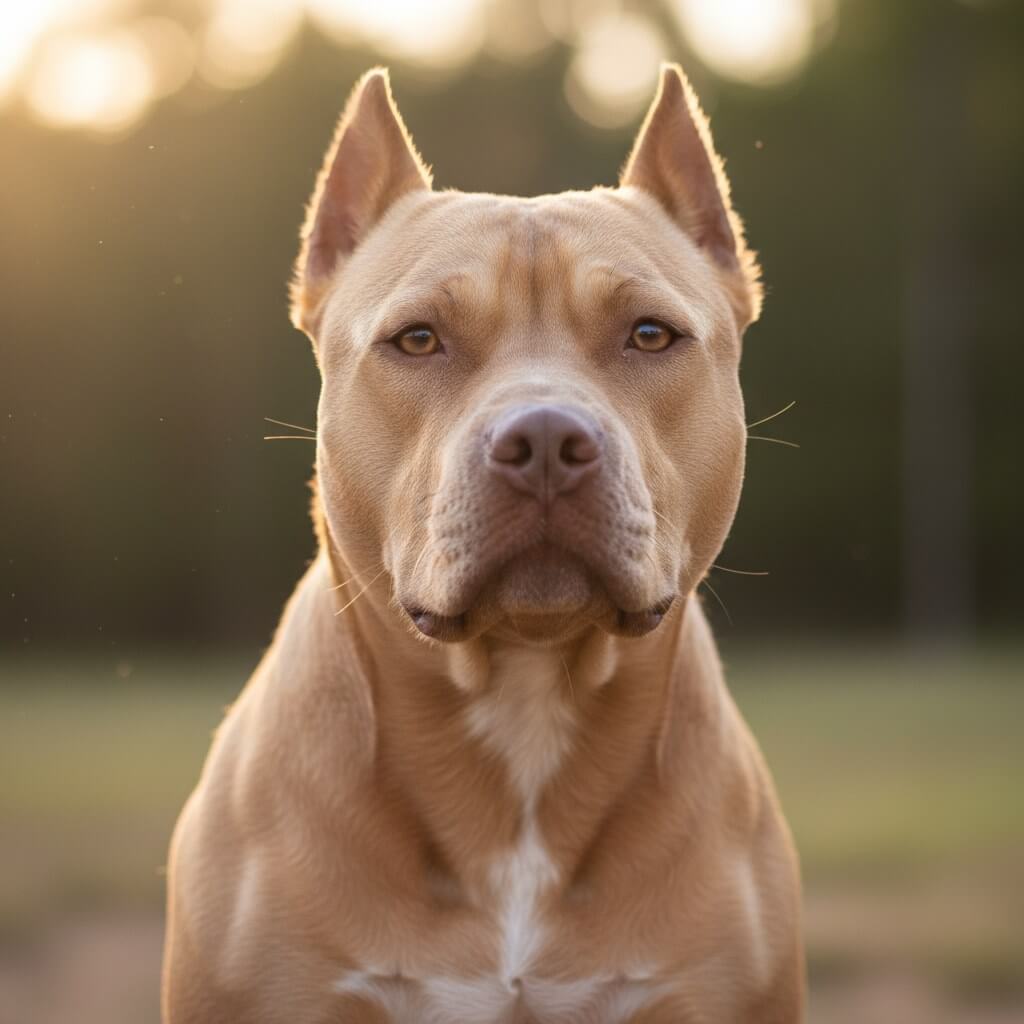
The APBT was bred in 19th-century Britain from bulldogs and terriers — the bulldog providing gameness and physical power, the terrier contributing drive and agility. Brought to America by immigrants, the breed was used for farm work, hunting, and unfortunately, pit fighting. After dogfighting was banned, the breed’s loyal and human-friendly temperament made it a popular family companion. Helen Keller owned one. So did President Theodore Roosevelt.
The Four Breeds Under the Pitbull Umbrella
1. American Pit Bull Terrier (APBT)
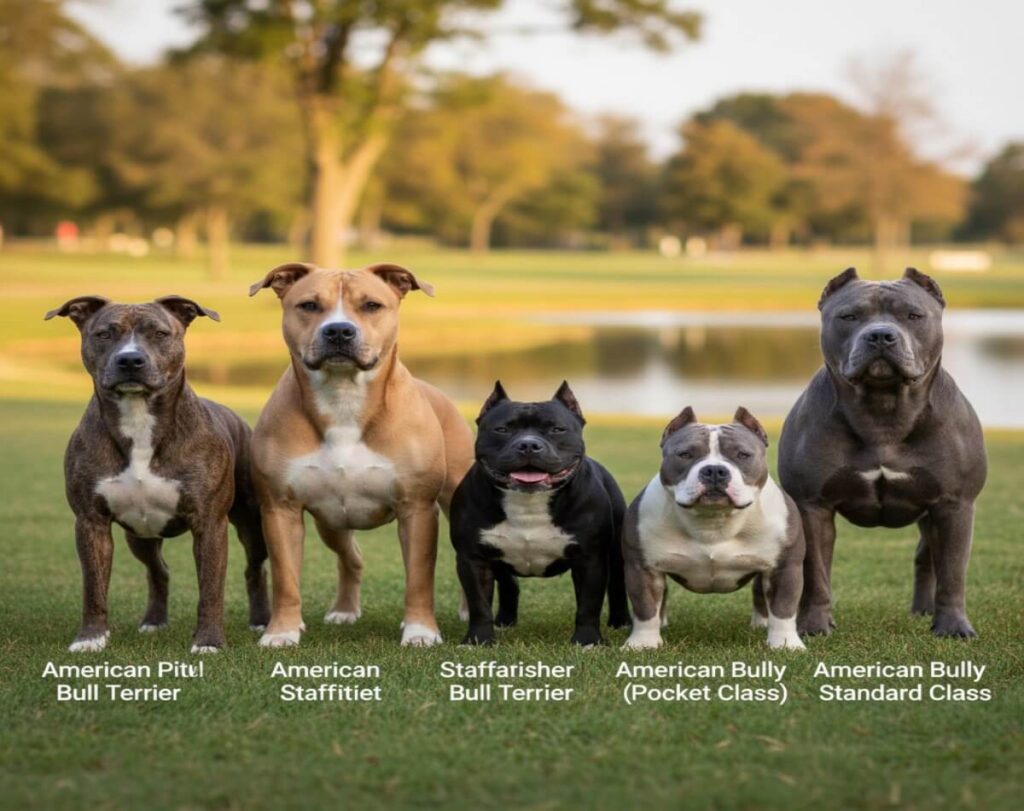
The foundation breed. Recognized by the UKC and ADBA. Medium-sized, athletic, with a lean but powerful build. Historically bred for gameness — meaning the mental drive to keep working through adversity. Highly energetic, people-oriented, and requires significant exercise and mental stimulation. Weight typically ranges from 30 to 65 lbs depending on sex and lineage.
2. American Staffordshire Terrier (AmStaff)
Recognized by the AKC. Shares deep ancestry with the APBT but has been selectively bred toward a show standard since the 1930s. Generally stockier and heavier-boned than the working APBT. Temperament is similar — confident and good-natured with humans — but the AmStaff tends to be slightly calmer due to generations of show-line breeding. Weight: 40–70 lbs.
3. Staffordshire Bull Terrier (Staffie)
The British cousin. Significantly smaller than the other three — typically 24–38 lbs — but pound for pound one of the most muscular dogs alive. Recognized by both the AKC and the UK Kennel Club. Known for being exceptionally gentle with children. Compact, low to the ground, and extremely affectionate with family members of all ages.
4. American Bully
The newest of the four, formally developed in the 1990s by crossing APBTs and AmStaffs with other bully breeds. Recognized by the ABKC and the UKC since 2013. Much heavier and more compact than the APBT, with an exaggerated blocky head and wide chest. Comes in four size classes: Pocket, Standard, Classic, and XL. Bred specifically as a companion dog — lower energy and drive than the APBT.
How to Identify Each Breed Visually
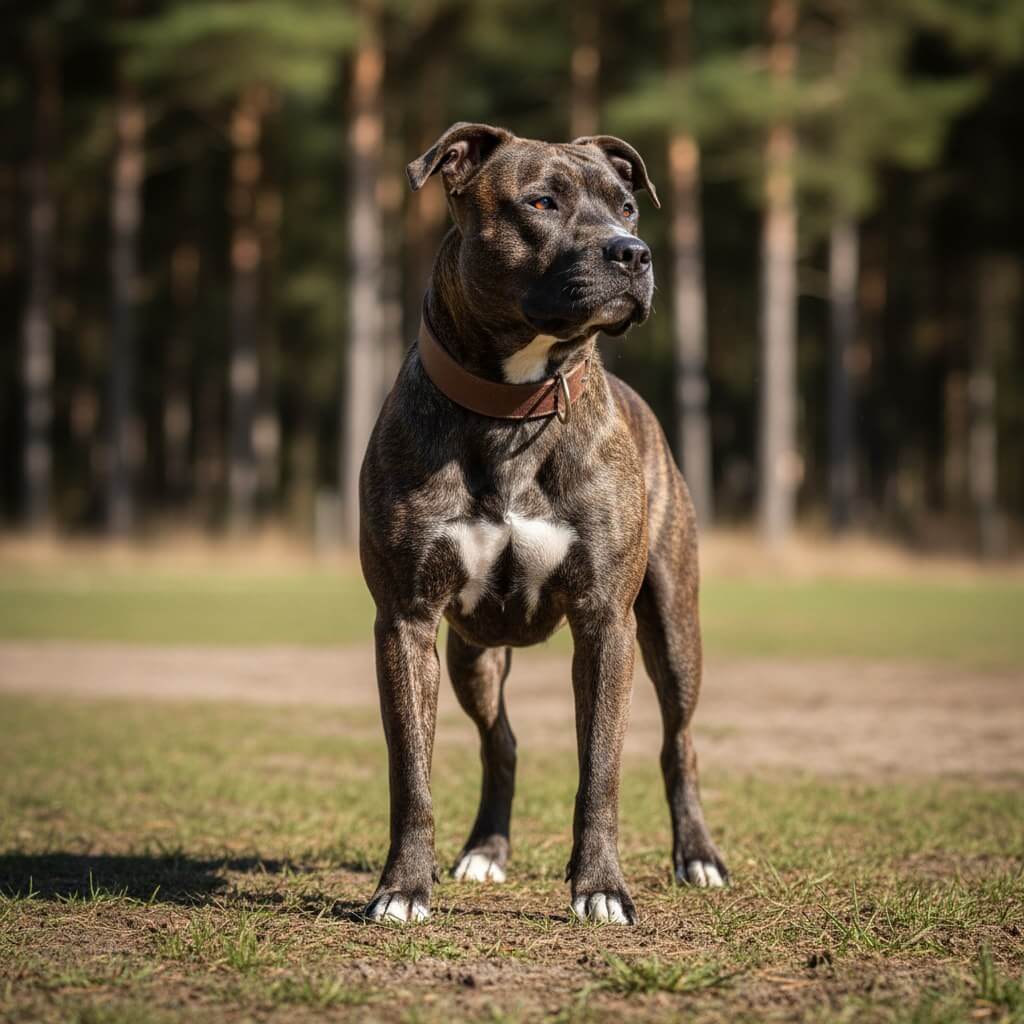
One of the most searched questions about pitbull-type dogs is simply: how do I tell them apart? Visual identification is genuinely difficult — even professionals get it wrong — but there are reliable physical markers that help narrow it down.
Head Shape
The APBT has a broad, flat skull with a well-defined stop and a medium-length muzzle. The AmStaff looks similar but typically has a slightly broader skull and heavier cheek muscles. The Staffie has a very short, broad head that looks almost round when viewed from the front — a notably different silhouette from the APBT. The American Bully has the most exaggerated head: extremely wide, with a very short muzzle and pronounced cheek muscles, especially in XL lines.
Body Proportions
The APBT is lean and athletic — you can often see muscle definition under the skin. The AmStaff is built similarly but slightly heavier through the chest and shoulders. The Staffie is low, wide, and compact — almost barrel-shaped through the ribcage despite its small size. The American Bully is the widest and heaviest, with a very low center of gravity and a chest that can appear nearly as wide as the dog is tall in extreme builds.
Size as a Quick Filter
If the dog weighs under 40 lbs and has a very broad, round head — it is almost certainly a Staffie or Staffie mix. If it weighs over 80 lbs with a blocky build — it is almost certainly an American Bully. Dogs in the 40–70 lb range with a lean, athletic build are more likely APBT or AmStaff territory, though mixed-breed ancestry always complicates visual identification.
Key tip: DNA testing (Embark, Wisdom Panel) is the only reliable way to confirm breed ancestry. Visual identification — even by experts — carries a documented error rate of over 50% in shelter studies.
Side-by-Side Comparison Table
| Trait | APBT | AmStaff | Staffie | American Bully |
|---|---|---|---|---|
| Weight range | 30–65 lbs | 40–70 lbs | 24–38 lbs | 30–130 lbs |
| AKC recognized | No | Yes | Yes | No |
| UKC recognized | Yes | Yes | Yes | Yes (2013) |
| Energy level | Very high | High | High | Moderate |
| Primary use today | Sport, companion | Show, companion | Companion | Companion |
| Average lifespan | 12–16 years | 12–16 years | 12–14 years | 8–13 years |
| Dog aggression risk | Moderate–High | Moderate | Moderate | Low–Moderate |
| Good with children | Yes (socialized) | Yes | Excellent | Yes |
| Exercise need daily | 90+ min | 60–90 min | 60–90 min | 30–60 min |
| Training difficulty | Moderate | Moderate | Moderate | Easy–Moderate |
Temperament: How They Actually Differ
Perhaps the most important thing a prospective owner needs to understand: all four of these breeds were selectively bred to be non-aggressive toward humans. Dogfighters historically culled dogs that showed human aggression — it was a liability in a pit environment where humans needed to handle and separate dogs mid-fight. This history produced dogs that are, paradoxically, often exceptionally gentle with people.
That said, same-sex dog aggression and a high prey drive are traits present to varying degrees across all four breeds — most prominently in the APBT. This is not the same as human aggression, and the two should never be conflated.
Important distinction: Human aggression and dog aggression are genetically separate traits. A pitbull-type dog that shows dog aggression is not displaying a warning sign for human aggression. Responsible ownership means understanding this difference clearly.
The American Bully was bred specifically to reduce drive and dog aggression while keeping the companion qualities. If you want a pitbull-type dog with the look but lower intensity, the Bully is the breed that fits. If you want the athletic, working-drive version — the dog that excels in weight pull, dock diving, and agility — the APBT is in a different class entirely.
The Staffordshire Bull Terrier occupies a unique space. Despite its fierce appearance, decades of British breeding have produced a dog with an almost surprising gentleness around children. Multiple independent temperament studies have rated Staffies among the highest-scoring breeds for family compatibility.
Training Differences Between the Four Breeds
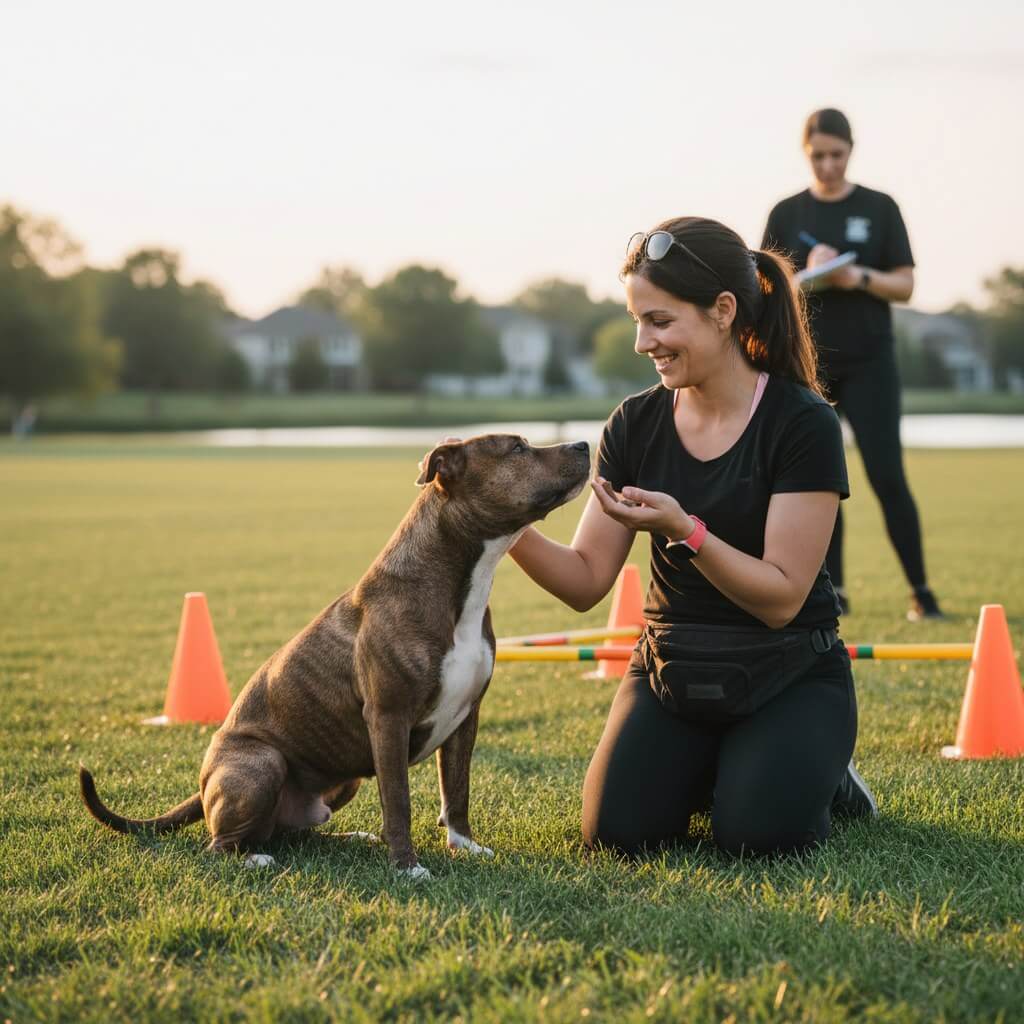
All four breeds are intelligent and respond well to positive reinforcement — but their drives, energy levels, and motivations differ enough that training approaches should be adjusted per breed.
Training the APBT
The APBT’s biggest strength in training is also its challenge: high drive. This breed is exceptionally motivated — by food, by play, by the work itself — which makes reward-based training highly effective. However, that same drive means the APBT can develop unwanted behaviors quickly if not given structured outlets. Consistent daily training sessions of 15–20 minutes, combined with a physical job (agility, weight pull, flirt pole), produces the best results. An under-stimulated APBT will find its own entertainment, and it will not be gentle about it.
Training the AmStaff
The AmStaff is generally considered the most straightforward of the four to train for a moderately experienced owner. It has strong food motivation, a desire to please, and slightly less raw drive than the working APBT. Show-line AmStaffs especially tend to be responsive and consistent. Early obedience training and leash manners are still essential — this is a strong dog and pulling on lead becomes a real problem if not addressed in puppyhood.
Training the Staffie
The Staffie is enthusiastic and eager but can be stubborn in a cheerful way — it will try hard for about ten minutes and then decide it has done enough. Short, fun sessions with high-value rewards work far better than long formal drills. This breed is exceptionally responsive to play-based training. The Staffie’s social nature means it does well in group classes, and early socialization with other dogs is particularly important given its moderate dog-aggression tendency.
Training the American Bully
The American Bully is perhaps the most naturally easy-going of the four to train from a temperament standpoint. Lower drive means it is less reactive and easier to manage in public. The challenge is the opposite of the APBT: the Bully can be somewhat lazy and may need extra motivation to engage. High-value treats, short sessions, and lots of enthusiasm from the handler keep a Bully engaged. XL Bullies especially need early leash training given their eventual size and strength.
Common Myths About Each Breed — Debunked
MYTH
“Pitbulls have locking jaws.”
FACT
No dog breed has a locking jaw mechanism. This is a biological impossibility — canine jaw anatomy is the same across all breeds. The myth likely originates from the APBT’s high pain tolerance and determination when biting, not any physical jaw structure. The American Veterinary Dental College has confirmed there is nothing anatomically unique about pitbull jaw structure.
MYTH
“All pitbull-type dogs are naturally aggressive toward people.”
FACT
The American Temperament Test Society (ATTS) has consistently found that APBT, AmStaff, and Staffie scores equal or exceed the national average for all breeds tested. The APBT has historically scored around 87% — higher than Golden Retrievers in some test years. Human aggression was actively bred out of these dogs for over a century.
MYTH
“The American Bully is just a bigger, more dangerous pitbull.”
FACT
The American Bully was specifically developed to reduce working drive and dog aggression. It is arguably the least intense of the four breeds discussed here. Its intimidating appearance is the result of selective breeding for aesthetics — its temperament was simultaneously bred toward calm companionship.
MYTH
“Staffordshire Bull Terriers are dangerous around children.”
FACT
The Staffie has one of the longest documented histories of safe cohabitation with children of any breed. The UK Kennel Club has for decades noted its exceptional patience and gentleness with young children. Responsible ownership and supervision — as with any dog — are still required, but the Staffie’s reputation in this area is well-earned and well-documented.
Health and Lifespan Differences
This is where the American Bully diverges most significantly from its cousins. The extreme conformation of XL and Extreme Bullies — the compressed muzzle, exaggerated muscle mass, short spine — introduces health complications that simply do not exist in the leaner APBT.
The APBT and AmStaff are generally considered robust breeds. Their primary health concerns are hip dysplasia, allergies (particularly environmental and food-related), and hereditary cataracts. With responsible breeding and proper care, lifespans of 14–16 years are achievable. For a deeper dive into how lifespan varies across the pitbull family, read our detailed guide on the life span of pitbulls.
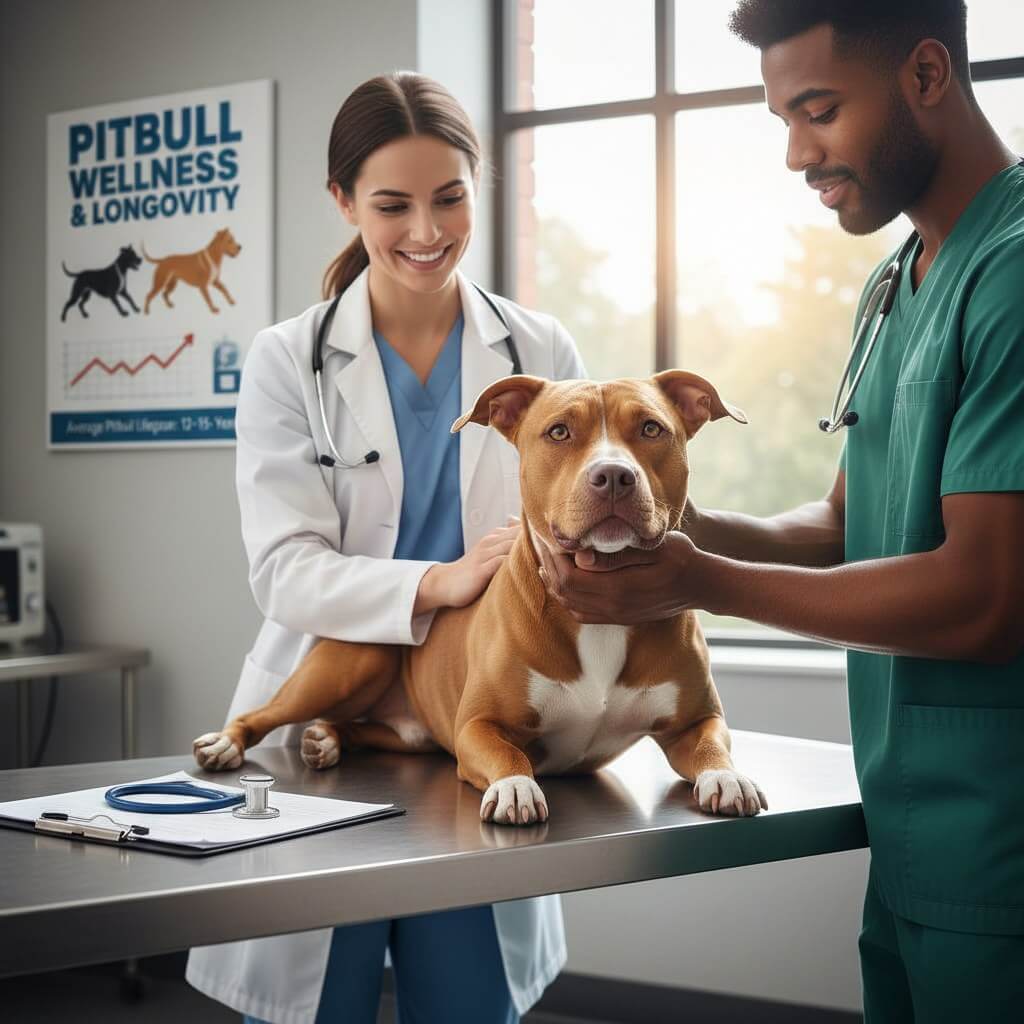
The Staffordshire Bull Terrier can be prone to juvenile hereditary cataracts (L-2HGA and HC) — a condition that responsible breeders now routinely test for. The AKC’s official Staffordshire Bull Terrier breed page lists the recommended health tests every buyer should request from breeders.
Skin and allergy issues are a common theme across all four breeds — arguably the most frequent veterinary complaint pitbull owners face. Our comprehensive resource on pitbull health problems covers what to watch for, breed by breed, with practical guidance on management.
For American Bullies — especially Extreme and XL variants — prospective owners should research brachycephalic obstructive airway syndrome (BOAS), heart conditions, and joint problems correlated with extreme build. The research published in Canine Genetics and Epidemiology has documented how extreme conformation selection affects health outcomes across bully breeds.
Breed-Specific Legislation and Misidentification
One of the most consequential facts about pitbull-type dogs is also one of the most under-discussed: visual breed identification is deeply unreliable. Multiple peer-reviewed studies have found that even experienced shelter workers, veterinarians, and animal control officers misidentify mixed-breed dogs as “pitbulls” at high rates — with DNA testing routinely revealing no pitbull ancestry in dogs that were labeled as such.
This matters because breed-specific legislation (BSL) — laws that ban or restrict ownership of pitbull-type dogs — relies almost entirely on visual identification. Denver, Miami-Dade, and several other jurisdictions have maintained these laws despite the American Veterinary Medical Association, the CDC, and the National Canine Research Council all opposing them on scientific grounds.
Understanding the actual physical standards of each breed — as detailed in this article — is one step toward more accurate identification. But the larger takeaway is that “pitbull” as a visual category is too broad and too ambiguous to serve as a reliable basis for policy or public safety assessment.
Which Pitbull Type Is Right for You?
The answer depends entirely on your lifestyle, experience level, and what you are looking for in a dog.
If you want a high-energy working partner for dog sports, weight pull, or agility — and you have experience managing a driven breed — the APBT is the authentic choice. It is the original, the athlete, and still the standard against which the others are measured.
If you want AKC recognition and a slightly more settled temperament, the AmStaff delivers most of the APBT’s qualities in a show-accepted package. The two are close enough that the difference will matter more to a breeder than to a family.
If you have young children and want a compact, affectionate companion with a proven track record, the Staffordshire Bull Terrier deserves far more attention than it gets in the United States. It is, in many respects, the most thoroughly family-tested of the four.
And if you want the aesthetic — the blocky head, the wide chest, the striking presence — with a calmer temperament and lower exercise demands, the American Bully was purpose-built for exactly that. Just choose your breeder carefully, and research the specific health implications of extreme conformation before committing.
Whichever breed you choose, the fundamentals remain constant: early socialization, positive reinforcement training, regular exercise, and proper veterinary care. These are, as generations of families have discovered, some of the most loyal and affectionate companions in the canine world — and they deserve owners who understand the real differences between them.
References & Sources
- United Kennel Club (UKC) — Official American Pit Bull Terrier Breed Standard
- American Kennel Club (AKC) — Breed Encyclopedia: American Staffordshire Terrier & Staffordshire Bull Terrier
- American Bully Kennel Club (ABKC) — Official Breed Standard
- American Veterinary Medical Association (AVMA) — Position Statement on Breed-Specific Legislation
- American Temperament Test Society (ATTS) — Breed Statistics
- Canine Genetics and Epidemiology — NCBI Research on Bully Breed Conformation