
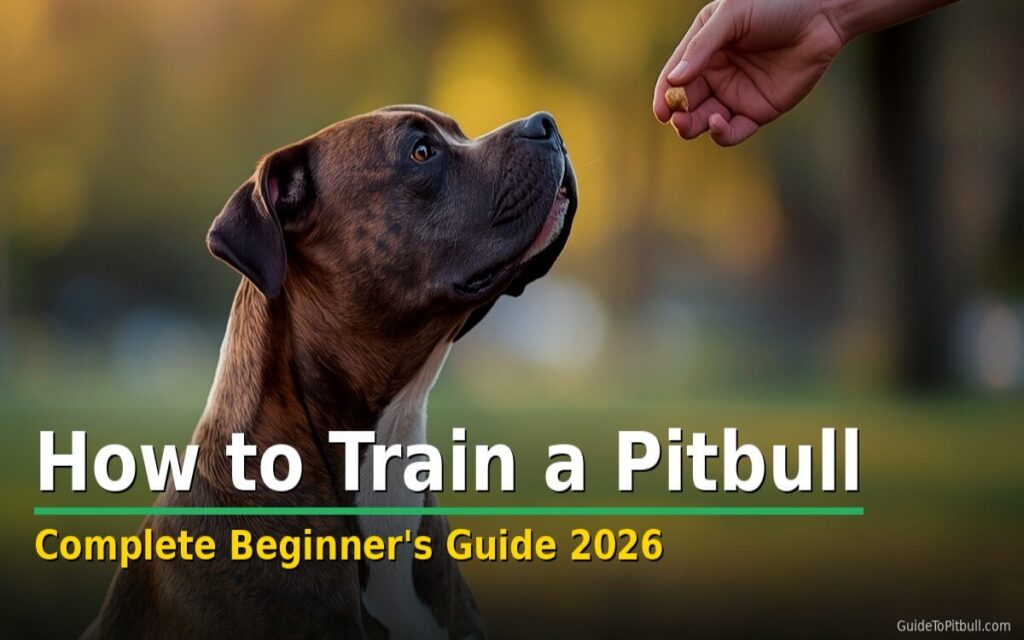
Most pitbull owners start training too late, use the wrong methods, or give up when progress feels slow. The result is a 60-pound dog with no reliable recall, leash manners, or impulse control — and a owner who believes the breed is simply “difficult.” The breed is not difficult. The approach is wrong. This guide fixes that from the beginning.
- Start training from day one — pitbulls absorb habits fastest between 8 and 16 weeks
- Positive reinforcement is the only method endorsed by the AVMA and major animal welfare bodies
- Training sessions should be 5–10 minutes maximum — short, frequent, and always ending on success
- Socialization window closes at 12–16 weeks — missing it has lifelong behavioral consequences
- Punishment-based training causes fear aggression in pitbulls more than in most breeds
- A well-trained pitbull is a breed ambassador — every interaction changes public perception
I have spent months researching pitbull-specific training science, reviewed published behavioral studies, and cross-referenced guidance from the American Kennel Club, the ASPCA, and board-certified veterinary behaviorists. What follows is the most complete, evidence-based pitbull training guide I could build — structured from puppy basics through adult obedience, with every method justified by the science behind it.

Why Pitbulls Are Actually Easy to Train (The Science Explains It)
The reputation pitbulls carry as “hard to train” dogs is one of the most persistent and damaging myths about the breed. The data tells a completely different story.
Pitbull-type dogs are classified as working dogs descended from terrier and bulldog crosses — breeds selected for responsiveness to human direction, physical stamina, and the desire to engage with a handler. These are precisely the traits that make a dog trainable. The American Pit Bull Terrier’s eagerness to please its owner is not a casual observation — it is a documented characteristic of the breed that experienced trainers consistently cite as a significant advantage.
The behavioral issues that most people associate with pitbulls — reactivity, pulling, jumping, selective listening — are not breed-specific problems. They are training deficits. The same deficits exist in Labs, German Shepherds, and every other high-energy breed when training is absent or inconsistent.
Understanding which pitbull type you own also matters for calibrating your training approach. A compact Staffordshire Bull Terrier has different energy output and drive characteristics than a 65-pound American Pit Bull Terrier.
🐕The 4 Core Principles Behind Every Method in This Guide
Reward the behavior you want. Dogs repeat behaviors that earn them good things. This is the single most scientifically validated training method for all breeds.
The reward must arrive within 2 seconds of the correct behavior. Late rewards teach nothing — they accidentally reward whatever the dog was doing when the treat arrived.
Every person in the household must use identical cues. A dog who hears “down,” “off,” “get down,” and “no” for the same behavior learns nothing reliable.
Master each behavior at home before adding distractions. A dog who sits perfectly in your kitchen is not ready to sit at a busy park — yet. Build to it.
Why Punishment-Based Training Fails Pitbulls Specifically
Aversive training methods — choke chains, prong collars, alpha rolls, shock collars — are not just ethically questionable. For pitbull-type dogs, they are actively counterproductive.
Pitbulls are physiologically and temperamentally more sensitive to perceived threats than their outward toughness suggests. A dog that experiences pain or fear during training does not learn the desired behavior — it learns that training situations are threatening. The predictable result is a dog that shuts down, becomes handler-avoidant, or develops defensive aggression. This is precisely how a dog ends up labeled “dangerous” when the training method was the actual problem.
The American Veterinary Medical Association, the ASPCA, and every major animal welfare body explicitly advise against aversive training methods. This guide uses none of them.
Pitbull Training by Age: What to Teach and When
Training a pitbull is not a single event — it is a developmental process that spans the first two years of the dog’s life and continues through maintenance and enrichment in adulthood. The following schedule reflects what is developmentally appropriate at each stage.
| Age Range | Training Focus | Session Length | Daily Frequency | Key Milestone |
|---|---|---|---|---|
| 8 – 12 weeks | Name recognition, sit, come, crate intro | 3–5 min | 4–5x/day | Responds to name reliably |
| 3 – 4 months | Sit, down, stay (2 sec), leash intro, socialization | 5–8 min | 3–4x/day | Sits on cue 8/10 times |
| 4 – 6 months | Stay (10–30 sec), heel, leave it, recall | 8–10 min | 2–3x/day | Solid recall in low-distraction environment |
| 6 – 12 months | Proofing commands with distractions, loose-leash walking | 10–15 min | 2x/day | Commands work in public settings |
| 1 – 2 years | Advanced obedience, CGC certification prep, tricks | 15–20 min | 1–2x/day | CGC test pass or equivalent |
| Adult (2+ years) | Maintenance, enrichment, ongoing socialization | 10–15 min | 3–4x/week | Consistent behavior across all environments |
* CGC = AKC Canine Good Citizen certification — a practical and widely recognized benchmark for a well-trained pitbull.

7 Essential Commands Every Pitbull Must Know
These are not optional extras. These seven commands form the behavioral foundation that determines whether your pitbull is safe to take into the world. Each one has a specific training protocol backed by behavioral science.
| Command | How to Teach It | Common Mistake | When Mastered |
|---|---|---|---|
| 🪑 Sit | Hold treat above nose, move back slowly — dog’s rear lowers naturally. Mark and reward the moment hips touch floor. | Pushing the dog’s rear down — creates resistance, not learning | Sits on verbal cue alone, 9/10 attempts |
| ⬇️ Down | From sit, lure treat toward floor between front paws. Mark and reward when elbows touch ground. | Forcing the dog down — destroys trust | Downs from standing position on verbal cue |
| 🛑 Stay | Ask for sit. Take one step back. If dog holds, return and reward. Add distance and duration gradually over weeks. | Increasing distance before duration — dog breaks early | Holds stay 30 seconds with owner 10 feet away |
| 📣 Come (Recall) | Crouch, open arms, say “come” in a happy tone. Never call dog to punishment — ever. Make coming to you the best thing that happens all day. | Calling dog then scolding it — destroys recall permanently | Comes immediately from across a distraction-heavy environment |
| 🚶 Heel | Reward dog for walking beside your left leg. Mark and treat every few steps of loose-leash walking. Stop immediately when leash tightens. | Allowing pulling sometimes — inconsistency makes leash pulling permanent | Walks loose-leash for a full block without redirecting |
| 🚫 Leave It | Show treat in closed fist. When dog backs away or makes eye contact, mark and give a different treat. Progress to floor objects over time. | Using the same treat as the lure and reward — confuses the dog | Leaves food, toys, or other dogs on verbal cue |
| 🤫 Off | When dog jumps, turn away and cross arms. As soon as four paws land, immediately reward. Never push dog down — this becomes play. | Pushing dog off with hands — accidentally rewards jumping | Keeps all four paws on floor when greeting strangers |
The Socialization Window: The Most Important 8 Weeks of Your Pitbull’s Life
Between approximately 3 and 16 weeks of age, a puppy’s brain is in a critical developmental period called the socialization window. During this window, exposure to people, animals, environments, sounds, and surfaces is not merely beneficial — it is neurologically formative. Neural pathways built during this period are largely permanent.
What this means practically: a pitbull puppy that encounters 50 different people, 10 different environments, and a variety of sounds before 16 weeks will have a fundamentally different nervous system response to novelty as an adult than one who spent those weeks in a single home with a single family.
| Socialization Category | Examples | Target Exposures | Before Age |
|---|---|---|---|
| People types | Men, women, children, elderly, uniforms, hats, beards | 50+ people | 16 weeks |
| Other animals | Dogs (vaccinated), cats, small animals — controlled, positive only | 10+ animals | 16 weeks |
| Environments | Streets, parks, car rides, elevators, shops, vet clinic | 20+ locations | 16 weeks |
| Surfaces & textures | Grass, gravel, metal grates, tile, wood, carpet | 10+ surfaces | 12 weeks |
| Sounds | Traffic, thunder recordings, vacuum, crowds, music | Daily varied exposure | 16 weeks |
| Handling | Ears, paws, mouth, body examination, nail touch | Daily | Ongoing |
Crate Training a Pitbull: The Right Way
Crate training is not confinement as punishment — it is the creation of a den, a space the dog chooses to occupy because it associates it with safety, rest, and reward. Done correctly, a crate-trained pitbull will voluntarily enter and rest in its crate with the door open.
- Introduce the crate before closing the door: Place the crate in a living area with the door open. Drop treats near it, then inside it. Let the dog investigate at its own pace over 1–3 days.
- Feed meals inside the crate: Move the food bowl progressively further inside until the dog eats comfortably with the door closed.
- Close the door briefly: Close the door for 10 seconds while the dog eats, then open. Increase duration by 10-second increments across multiple sessions over days.
- Add duration with you present: Ask the dog to enter, close the door, sit beside the crate for 5 minutes while the dog chews a Kong. Gradually extend to 30 minutes.
- Leave the room: Once the dog is settled for 30 minutes with you present, begin short absences. Return before any distress begins.
- Overnight crating: Only after the above steps are complete. Place the crate in or near the bedroom — isolation in a separate room accelerates separation anxiety.
Crate Size for Pitbulls
The crate should be large enough for the dog to stand, turn around, and lie down comfortably — nothing more. An oversized crate allows the dog to use one end as a toilet, defeating the housetraining purpose entirely. For most adult pitbulls, a 36-inch intermediate or 42-inch large wire crate is appropriate.
Leash Training a Pitbull: Stopping the Pull
A 50-pound pitbull pulling at full strength is not a nuisance — it is a genuine safety hazard. Leash manners are not optional for this breed. The following protocol has the highest evidence base for eliminating leash pulling without aversive equipment.
- The instant leash pressure begins, stop walking completely — become a statue
- Wait without speaking or correcting — do not engage the dog
- The moment the leash goes slack or the dog looks back at you, mark and reward immediately
- Continue walking — repeat every single time tension occurs
- In the first few weeks, you may cover 50 feet in 20 minutes. This is normal and temporary
- Consistency is everything — if you allow pulling even once when you are “in a hurry,” you extend training time significantly
Equipment Note
Front-clip harnesses (like the Ruffwear Front Range or PetSafe Easy Walk) are appropriate management tools while building leash skills — they reduce pulling without causing discomfort. Choke chains, prong collars, and shock collars are not recommended by the AVMA for any breed, and for pitbulls specifically, the fear and pain responses they trigger can create or worsen reactivity.
🥩7 Training Mistakes That Pitbull Owners Make Most Often
| Mistake | Why It Happens | The Consequence | The Fix |
|---|---|---|---|
| Starting training “later” | Waiting until the dog is “older and calmer” | Habits calcify — adult retraining takes 3–5× longer | Start day one |
| Repeating commands | “Sit… sit… SIT… sit down…” | Dog learns to wait for the 4th repetition | Say it once, wait, reset if no response |
| Inconsistent rules | Allowed on couch sometimes, not others | Dog cannot predict outcomes — anxiety and testing increases | Choose a rule and hold it 100% |
| Punishing recall | Calling dog then scolding for something it did earlier | Dog stops coming when called — permanently | Coming to you = always positive, always |
| Over-long sessions | Training until the dog is visibly tired or bored | Dog associates training with exhaustion — engagement drops | 5–10 min max, end on success |
| Skipping proofing | Assuming indoor behavior transfers to outdoors | Dog is perfectly behaved at home, chaos in public | Practice in 10+ different environments |
| Using aversive tools | Frustration with slow progress | Fear responses, handler avoidance, defensive aggression | Positive reinforcement only — always |

Signs Your Training Is Working — and When to Get Help
- Dog makes eye contact during training
- Responds to name reliably indoors
- Offers sits voluntarily for attention
- Loose leash 70%+ of walks
- Crate rests without vocalizing
- Comes when called in low-distraction settings
- Tail wags when training equipment appears
- Growling or snapping at owners
- Lunging at people on leash (not playful)
- Stiff body language around food/toys
- Hiding or fear response to training
- Aggression toward other dogs regardless of trigger
- Biting that breaks skin
- No improvement after 4 weeks of consistent training
Behavioral problems that involve true aggression — not excitability, not play biting — require a certified veterinary behaviorist (DACVB) or a certified applied animal behaviorist (CAAB), not a general obedience trainer. A well-credentialed professional who uses positive methods can address aggression safely and effectively. One who uses dominance theory or aversive tools will make the problem worse.
📅
Frequently Asked Questions
Final Thoughts
A well-trained pitbull is not a lucky exception. It is the predictable result of consistent positive reinforcement, appropriate socialization, and an owner who understands the difference between the breed’s reputation and the breed’s reality.
Every pitbull that walks on a loose leash, recalls reliably, and greets strangers calmly is a piece of evidence against the narrative that this breed cannot be trusted. That is not a small thing. The cumulative effect of thousands of well-trained pitbulls in public spaces is, over time, the only meaningful challenge to breed-specific legislation and media bias.
Train your dog. Train it well. The breed’s future reputation is partly in your hands.