
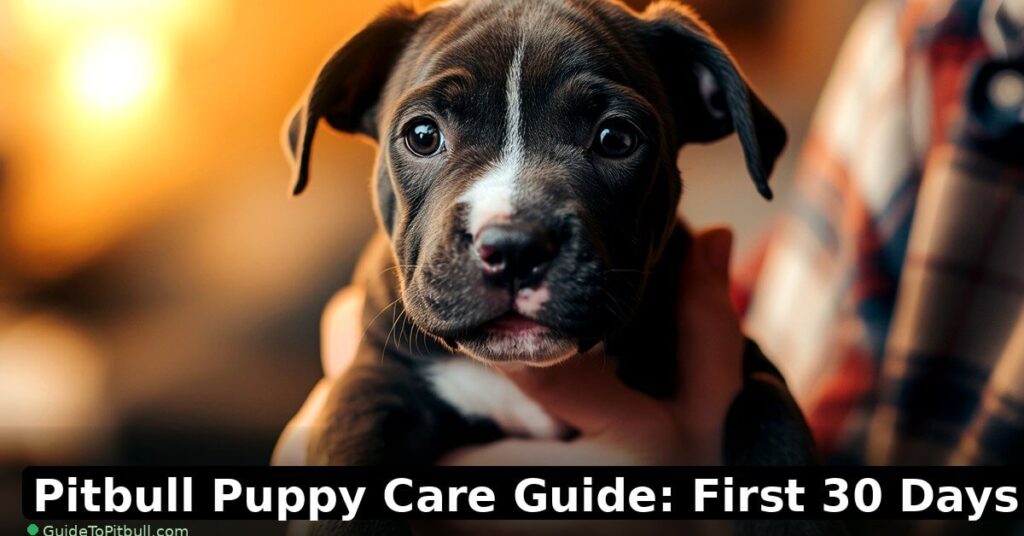
The first 30 days with a pitbull puppy are not about training obedience or building muscle. They are about one thing: building a foundation of trust, safety, and neurological health that will determine every behavior, health outcome, and emotional pattern your dog carries for the rest of its life. Most owners understand this intellectually. Very few have a practical, day-by-day framework for executing it. This guide provides exactly that.
- Vet appointment must happen within 72 hours of bringing your puppy home — no exceptions
- The socialization window is open and closing fast — every day of Week 1 counts neurologically
- Pitbull puppies need 22–28% protein in puppy food — standard adult formulas are not appropriate
- Vaccination series must begin at 6–8 weeks (DHPP) and continue every 3–4 weeks until 16 weeks
- Sleep is not laziness — pitbull puppies require 16–18 hours of sleep daily for healthy brain development
- The first night sets a pattern that can take weeks to undo — crate placement matters enormously
- Parvovirus is the single biggest threat to unvaccinated pitbull puppies in the first 30 days
I spent three months documenting what the research actually says about critical development in pitbull puppies — cross-referencing veterinary guidance, behavioral science, and the practical experience of long-term bully breed owners. The result is a week-by-week breakdown that is specific to pitbull physiology and temperament, not a generic puppy guide with the word “pitbull” inserted at the top.
Before Your Pitbull Puppy Arrives: The Setup That Changes Everything
The most consequential decisions you make for your pitbull puppy happen before the dog ever walks through your door. The environment it enters on day one creates its first neurological impressions of its new world — and those impressions are remarkably sticky.
Pitbull puppies are particularly environment-sensitive in their early weeks. Unlike some breeds that adapt easily to chaos, pitbull-type dogs form strong associations between environments and emotional states. A home that feels safe, consistent, and calm on day one gives the puppy’s nervous system a default setting of security. A home that feels overwhelming, unpredictable, or fear-inducing sets a very different baseline.
Set up crate and puppy area before arrival. The dog needs one consistent, calm zone that belongs to it from day one.
Secure exposed wires, remove chewable hazards at floor level, block off stairs and unsafe areas. Pitbull puppies are mouthy and nimble.
Get the exact food brand from the breeder. Continue for minimum 7–10 days before any transition. Sudden food changes cause digestive distress.
Book vet visit before puppy arrives. Target within first 72 hours. Bring all vaccination and deworming records from breeder.
The Crate: Getting It Right Before Day One
The crate is not a cage. For a pitbull puppy that is neurologically primed for den-like security, a properly introduced crate becomes a genuine refuge — a space the dog chooses because it associates it with rest, safety, and calm. The critical variable is size: a crate that is too large allows the puppy to toilet in one end and sleep in the other, which actively undermines housetraining. For most pitbull puppies, a 36-inch intermediate crate with a divider is correct at 8–12 weeks, expanding as the puppy grows.
Placement of the crate is equally important. Place it in your bedroom for the first 30 days — not in a utility room, not in the kitchen, not in an isolated corner of the house. Pitbull puppies are deeply social animals. Isolation on night one does not teach independence; it teaches that being alone means distress. Proximity to the owner while the puppy is crated creates security without dependency.
🎯Week-by-Week Breakdown: Days 1–30
The first week is not about training. It is not about socialization events, puppy classes, or exposing your puppy to as many new things as possible. The first week is entirely about one thing: helping a small animal whose entire world just changed adapt to its new environment safely.
Your pitbull puppy left its mother, its littermates, every familiar scent and sound, and every comfort it has ever known. The stress response this triggers is real and measurable. Cortisol levels in newly homed puppies are significantly elevated — research consistently shows that the quality of the first week’s environment directly impacts stress hormone recovery, which in turn affects immune function, digestive health, and early learning capacity.
| Day | Priority Task | What to Avoid | Expected Behaviour |
|---|---|---|---|
| Day 1 | Home tour (controlled), crate intro, first meal, first night | Visitors, loud noise, overwhelming handling | Whining, hesitation, exploratory sniffing |
| Day 2–3 | Establish potty routine, name recognition, gentle handling | Punishing accidents, ignoring the puppy completely | Some accidents, more curiosity, beginning to relax |
| Day 3–4 | Vet appointment — full wellness exam + vaccination check | Dog parks, contact with unvaccinated dogs | Normal energy starting to emerge |
| Day 5–6 | Short 3-min training sessions: name + sit only | Multi-command sessions, physical corrections | Responding to name, beginning to sit for treats |
| Day 7 | Review: eating well? Stool normal? Sleeping through crate? | Skipping vet if anything seems off | Establishing a routine pattern |
By week two, your pitbull puppy’s stress hormones should be declining and its natural personality beginning to emerge. This is when you will start to see whether your puppy is confident and forward, cautious and watchful, or somewhere in between — and this is critical information for how you proceed with socialization.
The socialization window for dogs is open from approximately 3 to 16 weeks of age. Every week of this period has different developmental weight. Week two falls in a zone where positive exposures are neurologically formative but the immune system is still building. This creates a genuine tension: the puppy needs exposure to the world, but outdoor and public exposure carries real parvo risk before the vaccination series is complete.
The resolution is controlled indoor socialization: people visiting your home, car rides, sounds, surfaces, and handling — all of which can be accomplished without placing an unvaccinated puppy on public ground.
🏥Week three is where intentional training begins in earnest. By now your puppy has had time to decompress, the routine is established, and the brain is primed for learning. The window between weeks three and twelve is neurologically the most efficient learning period in a dog’s life — neural pathways form faster, habituation happens more readily, and behavioral patterns are less entrenched than they will be at six months.
Week 3 Training Goals
Keep sessions short — 5 minutes maximum, 3 times per day. These are the only commands needed in week three.
- Sit — responding 8/10 times on verbal cue alone (no lure needed)
- Name recognition — turning toward you reliably from across a room
- Crate entry on cue — walking in willingly when directed
- Off — four paws on floor when greeting people (beginning stages)
- Potty signal — showing early signs of going to the door or signaling before elimination
| Assessment Area | Target by Day 30 | If Not Met | Action |
|---|---|---|---|
| Sleep | Through night in crate, minimal whining | Still waking every 2 hours | Move crate beside bed, add worn clothing |
| Potty training | Max 1–2 accidents per day | 5+ accidents daily | Increase potty frequency, reduce freedom |
| Basic commands | Sit 8/10, name 9/10 | No consistent response | Shorten sessions, increase treat value |
| Eating | Full meals, consistent stools | Soft stool, vomiting | Vet check — possible food intolerance |
| Vaccination | 2nd DHPP booster received | Not yet done | Book immediately — critical window |
| Handling | Accepts ear/paw/mouth exam calmly | Still snapping or withdrawing | Daily desensitization — slow and rewarded |
The fourth week is a consolidation and assessment week. By day 30, your pitbull puppy should show clear progress on its core skills and the household routine should feel predictable to both dog and owner. This is also the week for the second vet visit — typically the 10–12 week booster appointment, which is one of the most important in the puppy vaccination series.
Pitbull Puppy Vaccination Schedule: The Non-Negotiable Timeline
Pitbulls have a documented vulnerability to parvovirus that exceeds many other breeds. The research on this is unambiguous: bully breeds — including American Pit Bull Terriers, American Staffordshire Terriers, and American Bullies — are statistically over-represented in parvo cases, with some studies showing mortality rates in unvaccinated pitbull puppies approaching 80% without aggressive veterinary intervention.
This is not a reason for panic. It is a reason for strict adherence to the vaccination timeline.
| Age | Vaccine | Type | Interval | Notes |
|---|---|---|---|---|
| 6–8 weeks | DHPP (Distemper, Hepatitis, Parvo, Parainfluenza) | Core | From breeder | Verify with records at vet visit |
| 10–12 weeks | DHPP Booster #2 | Core | 3–4 weeks after first | Most critical booster for parvo |
| 14–16 weeks | DHPP Booster #3 + Rabies | Core + Legal | 3–4 weeks after second | Rabies legally required in most areas |
| 12–16 weeks | Bordetella (kennel cough) | Non-core | Once, then annually | Required if dog park or boarding |
| 12–16 weeks | Leptospirosis | Non-core | If outdoor risk | Discuss with vet based on environment |
| 1 year | All boosters | Annual | 12 months post-puppy series | Full wellness exam at same visit |
* Source: ASPCA Vaccination Guidelines for Dogs — aspca.org/pet-care/general-pet-care/vaccinations-your-pet
- Never allow an unvaccinated pitbull puppy on public ground — parks, sidewalks, pet stores, vet waiting rooms (carry your puppy)
- Parvo survives on surfaces for up to 12 months — infected ground remains dangerous long after visible signs are gone
- Symptoms: Bloody diarrhea, vomiting, lethargy, refusal to eat — emergency vet immediately if these appear
- Bleach is the only household disinfectant that kills parvo — 1:30 ratio, 10-minute contact time
Feeding a Pitbull Puppy: Nutrition Specific to the Breed
Generic puppy food nutritional guidelines do not account for breed-specific requirements. Pitbull-type dogs are mesomorphic working breed dogs — they have disproportionately high muscle mass relative to body weight, rapid growth rates, and a metabolism calibrated for athletic activity even in puppyhood. What this means practically: the protein requirements for a pitbull puppy are higher than the minimums set for dogs generally.
| Age | Daily Meals | Protein % Min | Portion Guide | Key Nutrient Focus |
|---|---|---|---|---|
| 8–12 weeks | 4 meals/day | 22–28% | ¼–½ cup per meal | DHA for brain, calcium for bones |
| 3–4 months | 3 meals/day | 22–28% | ½–¾ cup per meal | Phosphorus balance for joints |
| 4–6 months | 3 meals/day | 24–28% | ¾–1 cup per meal | Omega-3 for coat and skin |
| 6–12 months | 2 meals/day | 24–26% | 1–1.5 cups per meal | Glucosamine for joint development |
* Portions are guidelines only — adjust based on individual puppy’s body condition. Visible rib definition (not prominent ribs) is the target.
🥩Foods That Are Toxic to Pitbull Puppies
Pitbull puppies are indiscriminate eaters with powerful jaws and zero impulse control around food. The following items are commonly found in households and all are genuinely dangerous to puppies.
- Grapes and raisins — kidney failure, no safe dose
- Chocolate — theobromine toxicity, cardiac risk
- Xylitol (in gum, peanut butter) — rapid hypoglycemia
- Onions and garlic — destroys red blood cells
- Macadamia nuts — neurological symptoms
- Cooked bones — splinter risk, intestinal perforation
- Avocado — persin toxicity
- Alcohol in any amount — lethal at small doses
- Small pieces of cooked chicken breast
- Plain cooked sweet potato
- Carrot sticks — good for teeth development
- Blueberries — antioxidants, small amounts
- Plain cooked egg — protein boost
- Watermelon (seedless, no rind)
- Plain cooked salmon — omega-3
Socialization Exposure Tracker — First 30 Days
Use this as a practical checklist. Each exposure should be positive and controlled — never forced. If the puppy shows stress signals, reduce intensity immediately.
| Category | Examples | Target | Safe Before Vaccines? | Priority |
|---|---|---|---|---|
| People Types | Men, women, children, hats, beards, uniforms | 20+ people | ✅ Indoors only | High |
| Sounds | Traffic, thunder recordings, vacuum, TV, music | Daily variety | ✅ Yes — indoors | High |
| Surfaces | Carpet, tile, grass, gravel, metal, wood | 8+ surfaces | ✅ Controlled areas | Medium |
| Handling | Ears, paws, mouth, body, nails, brushing | Daily | ✅ Yes — always | High |
| Other Dogs | Vaccinated adult dogs, same-age puppies | 3–5 dogs | ⚠️ Vaccinated dogs only | Medium |
| Environments | Car rides, different rooms, outdoors (carried) | 10+ locations | ⚠️ Carry puppy outside | Medium |
| Objects | Umbrellas, bags, bicycles, strollers | 10+ objects | ✅ Yes — indoors | Low |
Sleep: The Most Underestimated Part of Pitbull Puppy Care
Most new puppy owners are surprised by how much a healthy pitbull puppy sleeps. The answer is: a lot. Between 16 and 18 hours per 24-hour period is normal and necessary in the first 30 days.
Sleep is not downtime for a developing brain — it is when the work of development actually happens. Memory consolidation, synaptic pruning, hormone regulation, immune function, and physical growth all occur primarily during sleep. A puppy that is being kept awake by enthusiastic handling, continuous play, or excessive stimulation is a puppy that is being deprived of its primary developmental process.
Warning Signs: When to Call the Vet Immediately
Pitbull puppies are stoic in ways that can mask illness. Unlike many breeds that become visibly lethargic early in an illness, pitbulls sometimes continue displaying normal energy until a condition has progressed significantly. This makes knowing the specific warning signs more important for this breed than for most.
| Symptom | Possible Cause | Urgency | Action |
|---|---|---|---|
| Bloody diarrhea | Parvovirus, parasites, hemorrhagic gastroenteritis | Emergency | Emergency vet immediately — do not wait |
| Repeated vomiting (3+) | Parvo, obstruction, poisoning | Emergency | Emergency vet — especially with lethargy |
| Refuses all food 24+ hours | Illness, stress, dental pain, obstruction | Urgent | Vet within same day |
| Pale or white gums | Anemia, internal bleeding, shock | Emergency | Emergency vet — serious sign |
| Distended abdomen | Bloat (GDV), parasites, obstruction | Emergency | Emergency vet — GDV is fatal within hours |
| Persistent coughing | Kennel cough, pneumonia, heart defect | Urgent | Vet within 24 hours |
| Eye discharge (yellow/green) | Infection, distemper, entropion | Urgent | Vet within 24–48 hours |
| Limping or non-weight bearing | Fracture, joint issue, panosteitis | Urgent | Vet within same day |
End of Month 1: Your 30-Day Milestone Checklist
- Have completed first and second vet visits with vaccination records up to date
- Sleep through the night in crate with minimal or no whining
- Respond to its name reliably in a low-distraction environment
- Sit on cue at least 7 out of 10 attempts
- Have a consistent potty routine with decreasing indoor accidents
- Accept handling of ears, paws, and mouth without significant resistance
- Eat full meals consistently with no vomiting or chronic loose stool
- Have been exposed to at least 10–15 different people safely
- Show curiosity rather than fear when encountering new sounds or surfaces
Frequently Asked Questions
Final Thoughts: The First 30 Days Set the Next 13 Years
Everything that determines whether your pitbull becomes a dog you can take anywhere, trust with anyone, and share your life with comfortably is shaped by decisions made in the first 30 days. Not entirely — dogs are resilient and trainable at every age — but foundationally.
The vaccination schedule, the first vet visit, the crate routine, the socialization exposures, the nutrition choices, the sleep environment — none of these are complicated in isolation. The difficulty is in the cumulative execution: doing all of them consistently, simultaneously, over 30 days of emotional adjustment and practical chaos.
That is what this guide was built to help you do. Use it as a reference document, not just a read-once article. Come back to the week-by-week tables, the vaccination schedule, the warning signs section. The first month is demanding. It is also the highest-leverage month of your dog’s life.