
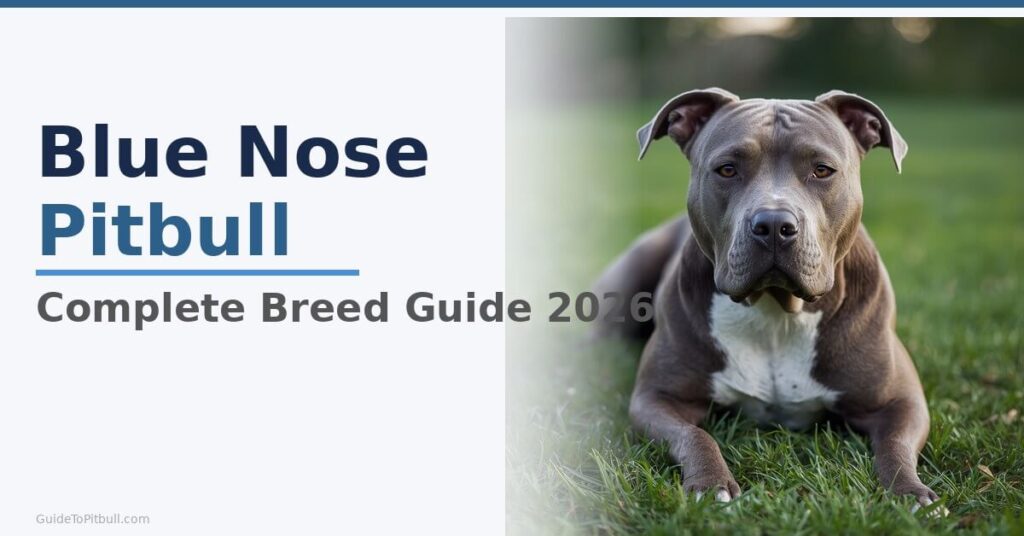
The Blue Nose Pitbull is one of the most searched, most misunderstood, and most frequently misrepresented dogs in the world. Breeders market them as rare and exotic. Rescue organizations struggle to rehome them. Legislation targets them. And somewhere in the middle of all this noise, the actual dog — a loyal, muscular, deeply affectionate animal — exists with a set of specific needs and genetic realities that most guides fail to address honestly. This one will not make that mistake.
- Blue Nose Pitbulls are NOT a separate breed — they are American Pit Bull Terriers with a recessive dilution gene
- The blue color comes from the “dd” genotype — both parents must carry two copies of the recessive gene
- Color Dilution Alopecia (CDA) is a real genetic risk — linked directly to the dilute gene, not a myth
- Price premium for blue coloration has no basis in health, temperament, or trainability
- Inbreeding to produce more blue puppies is the #1 health risk in this variation
- Temperament, trainability, and lifespan are identical to other American Pit Bull Terriers
- AKC does not recognize the American Pit Bull Terrier — UKC does, and color is not a separate classification
I have spent considerable time researching the genetics, health science, and breeding realities behind the Blue Nose Pitbull — cross-referencing veterinary literature, AKC genetics resources, and the documented health outcomes associated with dilute coat genes in dogs. What follows is the most complete, scientifically grounded Blue Nose Pitbull guide available — one that addresses the questions every prospective owner actually has, including the uncomfortable ones about breeding practices and health risks.
What Is a Blue Nose Pitbull? The Science Behind the Color
Before anything else, let us settle the most common misconception in this entire topic: the Blue Nose Pitbull is not a breed. It is not a sub-breed. It is not a rare hybrid. It is an American Pit Bull Terrier — or occasionally an American Staffordshire Terrier — that carries two copies of a recessive dilution gene, which reduces the eumelanin (black pigment) in the dog’s skin, nose, and coat to produce a blue-gray coloration.
The genetics are straightforward. Every dog inherits two copies of each gene — one from each parent. The dilution gene (called the “d” locus) operates on a simple recessive pattern. A dog needs two recessive copies (genotype: dd) to express the blue coloration. One copy (Dd) produces a carrier that looks normal. No copies (DD) produces a dog with no dilution at all.
The “d” locus dilutes black pigment (eumelanin) to a blue-gray. Requires two recessive copies — one from each parent.
Nose leather, eye rims, paw pads, toenails, and sometimes eyes — all affected by the same dilution gene.
In cold weather, blue noses may fade to pink or gray — this is normal seasonal pigment fluctuation, not illness.
Color Dilution Alopecia affects some dogs with the dd genotype — causing progressive hair loss and skin issues.
This genetic reality has several important practical implications that most Blue Nose Pitbull guides skip over entirely. First, the blue coloration tells you nothing about the dog’s temperament, health, intelligence, or quality as a companion animal. Second, the fact that two blue-nosed parents can produce puppies without the blue nose (if one parent is a carrier rather than homozygous) means that many “guaranteed blue” breeding claims are genetically inaccurate. Third — and most critically — the practice of repeatedly breeding blue-to-blue to maximize blue offspring dramatically increases inbreeding coefficients, which is the primary driver of the health problems that plague poorly-bred lines.
Blue Nose Pitbull Physical Characteristics: Size, Weight & Appearance
Physically, the Blue Nose Pitbull is indistinguishable from any other American Pit Bull Terrier except for its coloration. The musculature, bone structure, head shape, and body proportions are identical. This is important to understand because some breeders market Blue Nose Pitbulls as a physically distinct type — this is marketing, not biology.
| Physical Trait | Male | Female | Notes |
|---|---|---|---|
| Weight | 40–60 lbs | 30–50 lbs | Varies by bloodline — some larger |
| Height | 18–21 inches | 17–20 inches | Measured at shoulder |
| Head Shape | Broad, flat skull — well-defined jaw muscles | Not exaggerated like Bully type | |
| Coat Texture | Short, smooth, stiff — low maintenance | Glossy appearance when healthy | |
| Coat Color | Blue-gray (solid or brindle), often with white markings | Chest, face, paws common white areas | |
| Nose Color | Blue-gray to dark slate — never black | May fade seasonally (snow nose) | |
| Eye Color | Light gray, hazel, or amber — occasionally blue | Blue eyes may indicate merle gene issue | |
| Lifespan | 12–15 years | With proper care and ethical breeding | |
The Genetics of the Blue Nose: What Breeders Won’t Tell You
Understanding the genetics of the Blue Nose Pitbull is not just an academic exercise — it directly determines whether a puppy you are considering purchasing is likely to be healthy or not. The dilution gene itself does not cause health problems in all dogs. The health problems arise from what irresponsible breeders do in their attempt to reliably produce it.
When two blue-nosed parents are bred together, the genetic diversity of the litter is reduced. If those parents are also related — which is common in lines bred specifically for color — the inbreeding coefficient rises significantly. Research in canine genetics consistently shows that increased inbreeding correlates with higher rates of immune dysfunction, skin disorders, and early-onset health conditions. This is not a theory — it is documented in the veterinary literature on dilute-colored breeds across species.
| Breeding Combination | Blue Nose Offspring % | Genetic Risk Level | Recommended? |
|---|---|---|---|
| Blue (dd) × Blue (dd) | 100% Blue Nose | High if related | Only if unrelated dogs |
| Blue (dd) × Carrier (Dd) | ~50% Blue Nose | Medium | Better genetic diversity |
| Carrier (Dd) × Carrier (Dd) | ~25% Blue Nose | Lower risk | Best genetic health outcomes |
| Blue (dd) × Non-carrier (DD) | 0% Blue Nose | Lowest risk | Best for health — no blue offspring |
* Percentages are theoretical Mendelian probabilities — actual litter outcomes vary. Source: AKC genetics resources on recessive inheritance.
Blue Nose Pitbull Health: The Honest, Complete Picture
Health is where the Blue Nose Pitbull guide most guides get wrong — either by dismissing legitimate concerns entirely or by overstating them to the point of making the variation sound uniquely dangerous. The truth is more nuanced: well-bred Blue Nose Pitbulls from health-tested parents with diverse genetics can live long, healthy lives. Poorly-bred ones from inbred color-focused lines face a genuinely elevated risk of specific conditions.
| Health Condition | Blue Nose Specific? | Severity | Prevention | Management |
|---|---|---|---|---|
| Color Dilution Alopecia (CDA) | Yes — dilute gene | Moderate | Ethical breeding only | Medicated shampoos, sun protection |
| Skin Allergies | Higher risk in blue lines | Moderate | Diet quality, flea prevention | Elimination diet, vet dermatologist |
| Hip Dysplasia | Pitbull in general | Moderate | OFA screening of parents | Weight control, glucosamine, surgery |
| Hypothyroidism | Pitbull in general | Manageable | Thyroid panel at age 2+ | Daily medication — excellent prognosis |
| Juvenile Cataracts | Elevated in blue lines | Moderate | CAER eye exam of parents | Surgical removal if severe |
| Immune Disorders | Inbreeding-related | Serious | Avoid inbred lines | Veterinary management case by case |
| Demodectic Mange | Elevated in dilute lines | Moderate | Immune health, avoid stress | Veterinary treatment — highly treatable |
- CDA is a real genetic condition linked specifically to the dilute gene — not all blue dogs develop it, but the risk is elevated
- Symptoms: Dry, brittle coat starting in puppyhood → patchy hair loss → skin infections in bald areas
- There is no cure — management focuses on preventing secondary infections and reducing skin irritation
- Sun sensitivity: Affected dogs with exposed skin need sunscreen and limited midday sun exposure
- Does not shorten lifespan when properly managed — but adds lifelong veterinary costs
Blue Nose Pitbull Temperament: What the Data Actually Shows
The temperament of a Blue Nose Pitbull is the temperament of an American Pit Bull Terrier. Full stop. The blue coloration influences nothing about personality, behavior, intelligence, or trainability. Any breeder claiming that blue dogs have superior or inferior temperaments compared to other colored dogs is telling you something that has no basis in behavioral science.
- Blue Nose Pitbulls are more aggressive
- Blue coloring makes them calmer
- They are better guard dogs
- Rare color = superior genetics
- Blue nose means purebred status
- They need different training methods
- Color has zero effect on temperament
- Individual variation depends on breeding + socialization
- Same gentle, loyal APBT personality
- Rarity = recessive gene, not quality indicator
- Color doesn’t indicate registration status
- Training needs are identical to all pitbulls
American Pit Bull Terriers — including blue-nosed ones — are known for their people-orientation, eagerness to please, and high trainability. They form strong bonds with family members, are generally good with children when properly socialized, and respond exceptionally well to positive reinforcement training. The American Temperament Test Society records an 86% pass rate for APBTs — higher than Golden Retrievers.
🎯Blue Nose Pitbull Price: What You Should Pay & What’s a Red Flag
The price of a Blue Nose Pitbull is one of the most inflated in the dog market — driven entirely by perceived rarity of a coat color gene, not by any measurable quality advantage. Understanding what drives price — and what should drive price — is essential for any prospective buyer.
| Source | Price Range | Health Testing | Recommended? |
|---|---|---|---|
| Reputable ethical breeder | $1,200 – $2,500 | OFA, CAER, genetic panel | ✅ Best option |
| Average hobby breeder | $750 – $1,500 | Variable — always ask | ⚠️ Ask for health records |
| “Rare” color price premium | $2,500 – $5,000+ | Often minimal | ❌ Price not justified by genetics |
| Backyard breeder / Craigslist | $300 – $800 | Typically none | ❌ High health risk |
| Rescue / Shelter adoption | $50 – $400 | Basic vet check included | ✅ Excellent option |
Feeding a Blue Nose Pitbull: Breed-Specific Nutrition Needs
Because Blue Nose Pitbulls are American Pit Bull Terriers, their nutritional requirements are identical to the breed generally — with one additional consideration: the elevated skin sensitivity and allergy predisposition in blue lines makes food quality more consequential for this variation than for most other dogs.
- Protein: Minimum 24–28% from named animal sources — especially important for muscle maintenance in athletic builds
- Omega-3 fatty acids: Critical for skin and coat health — particularly relevant given CDA and allergy risk in blue lines
- No common allergens: Many blue pitbulls are sensitive to beef, chicken, dairy, and wheat — consider fish or novel proteins
- Avoid grain-free legume-heavy diets: FDA investigation links these to dilated cardiomyopathy — especially in breeds with cardiac risk
- Feeding frequency: 2 meals/day for adults — 3-4 meals for puppies under 6 months
- Body condition: You should feel but not prominently see ribs — obesity accelerates joint problems in this breed
How to Find a Reputable Blue Nose Pitbull Breeder: The 10-Point Checklist
This section is the most practically important in the entire guide. A Blue Nose Pitbull from a responsible breeder is a genuinely excellent companion animal. One from an irresponsible color-focused breeder is a gamble that may result in a dog with lifelong skin problems, immune issues, and genetic conditions that are expensive to manage and painful to watch. The difference between the two is almost entirely determined by the breeder you choose.
| # | What to Look For | Red Flag | Green Flag |
|---|---|---|---|
| 1 | Health testing | No OFA, CAER, or genetic testing | OFA hip + elbow + cardiac + CAER eye |
| 2 | Breeding purpose | “We breed for blue color only” | “We breed for health, temperament, structure” |
| 3 | Meet parents | Refuses to show dam/sire | Both parents available to meet |
| 4 | Price justification | “Rare blue” premium without health testing | Price reflects health investment, not color |
| 5 | Inbreeding | Same bloodlines in both parents | Coefficient of inbreeding under 6.25% |
| 6 | Contract | No health guarantee, no return policy | Written health guarantee + return clause |
| 7 | Socialization | Puppies kept isolated until pickup | Puppies handled daily, exposed to sounds/people |
| 8 | Follow-up support | No contact after sale | Available for questions throughout dog’s life |
| 9 | Registration | Claims AKC registration for APBT | UKC registration or honest explanation of status |
| 10 | Waitlist | Always has puppies immediately available | Waitlist suggests selective, limited breeding |
Frequently Asked Questions
Final Thoughts: Is a Blue Nose Pitbull Right for You?
The Blue Nose Pitbull is exactly what the data says it is: an American Pit Bull Terrier with a coat color gene. Not a superior version of the breed. Not an inferior one. Not a separate animal requiring different care. A loyal, athletic, affectionate, trainable companion that happens to have a blue-gray nose.
The questions that should drive your decision have nothing to do with nose color and everything to do with the dog in front of you: Where did it come from? Were its parents health-tested? What is its early socialization history? Can you meet its energy and training needs? Is it legal in your area?
If you can answer those questions satisfactorily — and if you are prepared for the commitment that comes with a high-energy, people-oriented working breed — then a Blue Nose Pitbull can be one of the most rewarding dogs you will ever own.