
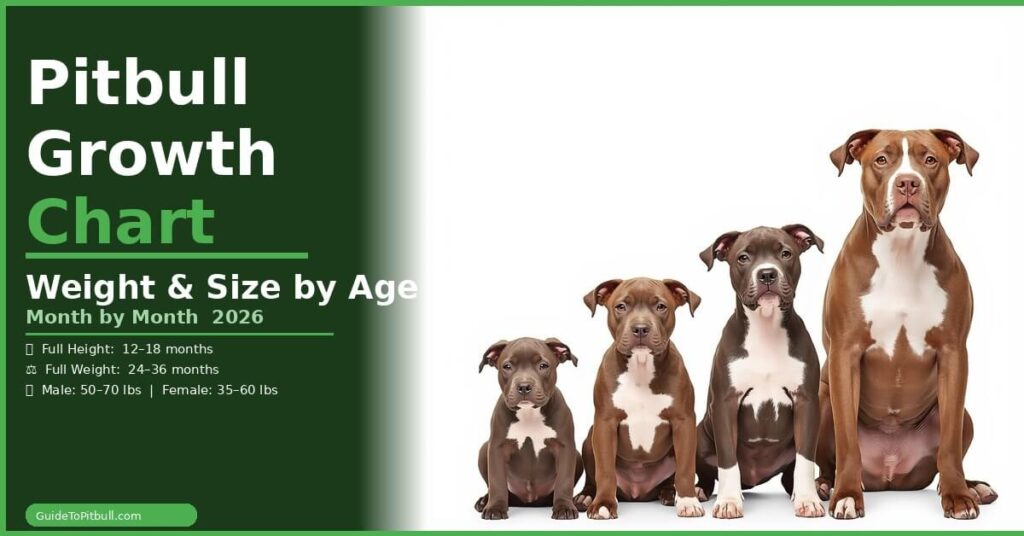
Your pitbull puppy weighed 10 pounds at eight weeks. Now, four months later, he is nearly 35 pounds and still growing. Is that normal? Is he on track? When will he stop? These are the questions every pitbull owner asks — and the answers require more than a single chart. Growth varies significantly by sex, genetics, nutrition, and spay/neuter timing. This guide gives you the complete picture: month-by-month weight and height data for both males and females, the developmental stages that matter, the factors that control final size, and the warning signs that indicate a problem.
- Pitbulls reach full height at 12–18 months but continue gaining muscle mass until 24–36 months
- The fastest growth period is between 3 and 6 months — owners often notice visible changes week to week
- Adult male APBT: 35–65 lbs, 18–21 inches tall | Female: 30–55 lbs, 17–20 inches tall
- Growth plates remain open until 12–18 months — high-impact exercise before this risks joint damage
- Early spay/neuter (before 12 months) can produce taller but leaner dogs with increased joint risk
- The rib test is the most reliable at-home body condition check — ribs felt but not seen = ideal
- Color (blue nose, red nose) has zero effect on ultimate size — genetics and sex are the primary drivers
The data in this guide is based on established ranges from veterinary literature for American Pit Bull Terriers and American Staffordshire Terriers — the two most common breeds referred to as pitbulls. Because “pitbull” encompasses several breeds, individual variation is significant. Use these charts as a reference range, not an absolute target, and consult your veterinarian if you have specific concerns about your dog’s growth trajectory.
Complete Pitbull Growth Chart: Weight by Age Month by Month
The table below covers both male and female American Pit Bull Terriers from birth through full maturity. These ranges reflect the normal variation across well-bred, healthy individuals. Your dog may fall anywhere within these ranges — or slightly outside them — without this indicating a problem. What matters is consistent, steady progress along a stable growth curve, not matching a specific number at each checkpoint.
| Age | Male Weight (lbs) | Female Weight (lbs) | % Adult Weight | Growth Phase | Key Milestone |
|---|---|---|---|---|---|
| Birth | 0.5 – 2 lbs | 0.5 – 1.5 lbs | ~2% | Newborn | Eyes/ears closed, nursing only |
| 1 Month | 4 – 7 lbs | 3 – 6 lbs | ~8% | Neonatal | Eyes open, first steps |
| 2 Months | 8 – 14 lbs | 6 – 12 lbs | ~18% | Early Puppy | Goes to new home — socialize now |
| 3 Months | 15 – 22 lbs | 12 – 18 lbs | ~28% | Fast Growth | Baby teeth complete, first vaccines |
| 4 Months | 22 – 32 lbs | 18 – 26 lbs | ~40% | Rapid Growth | Fastest growth rate — looks “gangly” |
| 5 Months | 28 – 40 lbs | 22 – 32 lbs | ~52% | Rapid Growth | Adult teeth starting to emerge |
| 6 Months | 32 – 48 lbs | 26 – 38 lbs | ~62% | Rapid Growth | Reduce to 2 meals/day, adult teeth in |
| 7 Months | 35 – 50 lbs | 28 – 40 lbs | ~68% | Steady Growth | Adolescent energy peaks |
| 8 Months | 37 – 53 lbs | 29 – 42 lbs | ~72% | Steady Growth | Separation anxiety may appear |
| 9 Months | 38 – 55 lbs | 30 – 44 lbs | ~76% | Steady Growth | Near full height, muscle building |
| 10 Months | 39 – 57 lbs | 31 – 46 lbs | ~80% | Slowing | Growth plates beginning to close |
| 11 Months | 40 – 58 lbs | 32 – 48 lbs | ~85% | Slowing | Height nearly complete |
| 12 Months | 40 – 62 lbs | 32 – 52 lbs | ~88% | Filling Out | Full height reached — transition to adult food |
| 18 Months | 43 – 65 lbs | 34 – 55 lbs | ~94% | Filling Out | Growth plates confirmed closed |
| 24 Months | 45 – 68 lbs | 35 – 58 lbs | ~98% | Near Mature | Muscle mass near peak |
| 36 Months | 50 – 70 lbs | 35 – 60 lbs | 100% | Full Maturity | Final adult weight confirmed |
* Ranges reflect American Pit Bull Terrier and American Staffordshire Terrier averages. Mixed breeds and American Bullies may vary significantly. Always consult your veterinarian for breed-specific guidance.
Pitbull Height Chart by Age: When Do They Stop Growing Taller?
Height and weight follow different timelines in pitbulls. Most pitbulls reach their full standing height — measured at the shoulder (withers) — by around 12 months of age. However, they continue to fill out, gain muscle, and increase in body weight for another 12 to 24 months after that. This is an important distinction because many owners assume their dog is “done growing” once height stabilizes, but the muscular development phase is where the iconic pitbull physique is actually built.
| Age | Male Height | Female Height | Growth Status | Exercise Note |
|---|---|---|---|---|
| 3 Months | 8 – 11 inches | 7 – 10 inches | Active Growth | Short walks only — no jumping |
| 6 Months | 12 – 16 inches | 11 – 15 inches | Fast Growth | No sustained running — plates open |
| 9 Months | 15 – 19 inches | 14 – 18 inches | Slowing | Moderate exercise — avoid hard surfaces |
| 12 Months | 17 – 21 inches | 16 – 19 inches | Full Height | Most exercise types now appropriate |
| 18 Months | 18 – 21 inches | 17 – 20 inches | Confirmed | All exercise types appropriate |
| Adult | 18 – 21 inches | 17 – 20 inches | Mature | 60–90 min daily exercise recommended |
- Growth plates close between 12–18 months — according to the AKC’s Chief Veterinarian Dr. Jerry Klein, DVM, jogging and high-impact activities should be avoided until plates are fully fused
- Hard surfaces accelerate joint wear — keep young pitbulls exercising on grass or sand until 14 months minimum
- Jumping is high risk — landing force can damage open growth plates in dogs under 12 months
- Repetitive ball chasing involves sudden stops and direction changes — limit this before 12 months
7 Factors That Determine Your Pitbull’s Final Size
Understanding what controls your pitbull’s ultimate size helps you manage expectations accurately and make better decisions about nutrition, exercise, and veterinary care during the growth phase. These seven factors work in combination — no single one determines the outcome.
The single strongest predictor. Parents’ size is the most reliable indicator of adult size — look at both parents if possible.
Males are consistently 5–15 lbs heavier and 1–2 inches taller than females at comparable ages and genetics.
High-quality protein (24–28%) supports muscle development. Poor diet during growth produces dogs that never reach genetic potential.
Before 12 months = taller but leaner dogs. Sex hormones signal growth plate closure — early removal delays this.
Appropriate exercise builds muscle. Excessive high-impact exercise before 12 months risks growth plate damage.
Parasites, illness, or poor gut health during puppyhood can permanently stunt growth — early vet care matters.
Pitbull Feeding Chart by Age: How Much to Feed During Each Growth Stage
Nutrition directly controls how well your pitbull realizes its genetic growth potential. Underfeeding produces dogs that fall short of their potential size and muscle mass. Overfeeding — particularly with calcium-rich foods in puppyhood — can accelerate growth in ways that stress developing bones and joints. The goal is steady, controlled growth on a high-quality, protein-rich diet.
| Age | Meals Per Day | Amount Per Day | Food Type | Key Nutrition Note |
|---|---|---|---|---|
| 6–8 Weeks | 4 meals | ½ – ¾ cup | Puppy kibble (softened) | Transition slowly from mother’s milk |
| 8–12 Weeks | 4 meals | ¾ – 1 cup | High-quality puppy kibble | 24%+ protein — named meat source first |
| 3–4 Months | 3–4 meals | 1 – 1.5 cups | High-quality puppy kibble | Fastest growth — do not restrict calories |
| 4–6 Months | 3 meals | 1.5 – 2 cups | High-quality puppy kibble | Watch Ca:P ratio — 1.1–1.3:1 ideal |
| 6–9 Months | 2–3 meals | 2 – 2.5 cups | Puppy or large breed puppy | Transition to 2 meals if digestion allows |
| 9–12 Months | 2 meals | 2 – 2.5 cups | Puppy kibble | Continue puppy food until 12 months |
| 12–18 Months | 2 meals | 2 – 3 cups | Transition to adult | 2-week gradual switch to adult formula |
| 18+ Months | 2 meals | 2.5 – 3.5 cups | High-quality adult kibble | Adjust by weight and activity level |
* Cup measurements based on standard kibble. Always follow manufacturer’s feeding guidelines for your specific food, adjusted for your dog’s actual weight and activity level.
🏥Pitbull Body Condition Score: Is Your Dog the Right Weight?
A number on a scale tells you weight. A Body Condition Score (BCS) tells you whether that weight is appropriate for your individual dog’s frame and muscle development. For pitbulls — an athletic, muscular breed — BCS is more meaningful than raw weight because two 50-pound pitbulls can have dramatically different body compositions.
| BCS Score | Description | What You See/Feel | Action Required | Status |
|---|---|---|---|---|
| 1 – 2 | Severely Underweight | Ribs, spine, hip bones clearly visible from across the room | Vet visit immediately — rule out illness | Urgent |
| 3 | Underweight | Ribs easily visible, minimal fat cover, waist very pronounced | Increase food, vet check for parasites | Action Needed |
| 4 | Slightly Lean | Ribs felt easily, slight waist visible — borderline | Slight food increase, monitor weekly | Monitor |
| 4.5 – 5 | Ideal | Ribs easily felt but not seen, defined waist, slight abdominal tuck | Maintain current feeding — perfect | ✅ Ideal |
| 6 | Slightly Overweight | Ribs felt with light pressure, waist barely visible | Reduce food 10%, increase exercise | Adjust |
| 7 | Overweight | Ribs require firm pressure to feel, waist not visible | Reduce food 15–20%, vet consultation | Action Needed |
| 8 – 9 | Obese | Ribs cannot be felt, heavy fat deposits, no waist | Veterinary weight management plan needed | Urgent |
- Place your hands flat on your dog’s sides, thumbs along the spine
- Gently press with your fingertips along the rib cage
- Ideal result: You can feel each rib distinctly with gentle pressure, but cannot see them standing still
- Too thin: Ribs visible without pressing — you can count them from across the room
- Too heavy: You have to press firmly before you feel ribs — they’re buried under fat
- Perform this test monthly and record results — trends matter more than single measurements
When Is a Pitbull Fully Grown? The Complete Timeline
The answer depends on what you mean by “fully grown.” Pitbulls mature in phases — height, weight, and behavioral maturity each follow distinct timelines that many owners conflate into a single milestone.
12–18 months. Most pitbulls stop growing taller by 12 months. Larger individuals may continue until 18 months.
18–24 months for most. Some heavy-boned males continue gaining muscle mass until 36 months.
24–36 months. The iconic pitbull chest and shoulder definition is typically complete by 2–3 years.
3–4 years. Pitbulls are known for retaining puppy energy well into adulthood — calming significantly at 3–4 years.
Frequently Asked Questions
Final Thoughts: Tracking Your Pitbull’s Growth Correctly
The most important thing to understand about pitbull growth is that the charts are reference ranges, not report cards. A dog that consistently tracks at the lower end of a weight range but maintains ideal body condition, good energy, and a healthy coat is growing exactly as it should. A dog that hits the middle of every chart but has ribs buried under fat is not.
Weigh your pitbull monthly during the growth phase. Perform the rib test monthly. Keep records. And if you notice a significant departure from your dog’s established growth curve — either faster or slower — that is the signal to consult your veterinarian, not to adjust feeding based on a chart alone.
The data exists to help you ask better questions at the vet. Your veterinarian’s assessment of your individual dog — accounting for their specific breed, sex, activity level, and health history — is always the authoritative answer.