
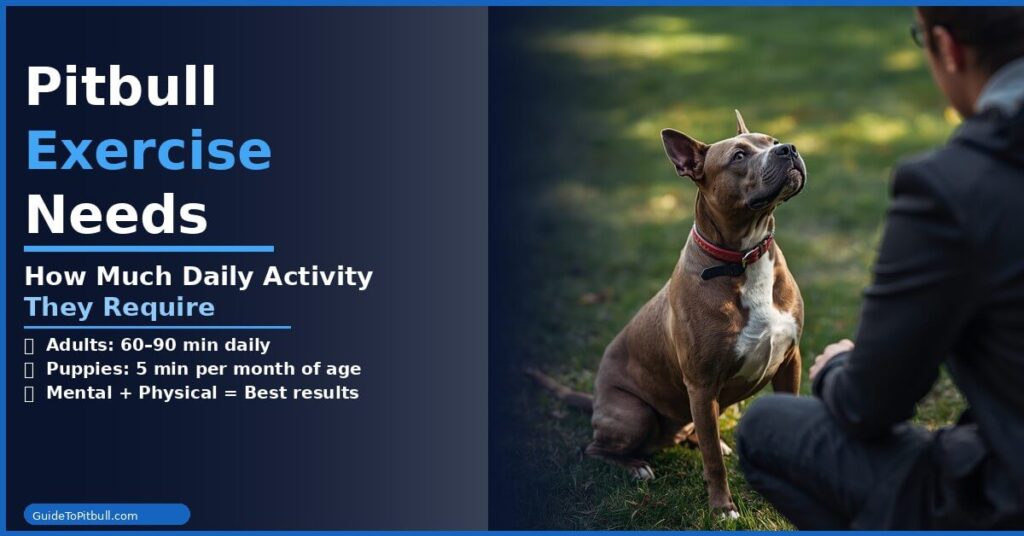
A pitbull that is not getting enough exercise is not a bad dog. It is a fit, strong, working-breed athlete trapped in a too-small routine — and it will tell you about it through chewed furniture, excessive barking, restlessness, and behaviors that frustrate owners who mistake energy for aggression. Exercise is not optional for pitbulls. It is the single most controllable factor in their behavior, health, and quality of life. This guide tells you exactly how much they need, what kinds of activity work best at each life stage, and the warning signs that you are giving them too much — or too little.
- Adult pitbulls need 60–90 minutes of genuine physical activity daily — not just a slow walk around the block
- Puppies follow the 5-minute rule: 5 minutes of exercise per month of age, twice daily maximum
- Growth plates close at 12–18 months — high-impact exercise before this risks permanent joint damage
- Mental stimulation is equally important — a bored pitbull is a destructive pitbull regardless of physical exercise
- Senior pitbulls (7+) still need daily movement — 30–45 minutes of low-impact activity maintains joint health
- Self-exercise in a yard is NOT sufficient — pitbulls need structured activity with their owner
- Overexercise signs are as dangerous as underexercise — know both and respond immediately
The research behind pitbull exercise requirements is clear and consistent across veterinary literature. What varies is the application — because a 6-month-old puppy, a 3-year-old adult, and a 9-year-old senior have completely different needs that require completely different approaches. This guide addresses all of them.
How Much Exercise Does a Pitbull Need? The Complete Answer by Age
The most commonly cited figure — “one to two hours per day” — applies specifically to healthy adult pitbulls between roughly 2 and 7 years of age. For every other life stage, the requirements are different, and applying adult exercise standards to puppies is one of the most common and damaging mistakes pitbull owners make.
| Life Stage | Age | Daily Exercise | Sessions/Day | Intensity | Primary Rule |
|---|---|---|---|---|---|
| Newborn Puppy | 0–8 Weeks | Free play only | Natural | Very Low | No structured exercise at all |
| Young Puppy | 2–3 Months | 10–15 min | 2–3 short | Low | 5 min per month of age rule |
| Puppy | 3–5 Months | 15–25 min | 2–3 short | Low | No jumping or hard surfaces |
| Puppy | 5–7 Months | 25–35 min | 2–3 sessions | Low–Med | Grass/sand only — no sustained running |
| Older Puppy | 7–12 Months | 35–45 min | 2 sessions | Medium | Growth plates still open — no jogging |
| Adolescent | 12–18 Months | 45–60 min | 2 sessions | Med–High | Gradual increase as plates close |
| Young Adult | 18 Mo–3 Yrs | 60–90 min | 2 sessions | High | Full exercise range now appropriate |
| Prime Adult | 3–7 Years | 60–90 min | 1–2 sessions | High | Daily minimum — non-negotiable |
| Senior | 7–10 Years | 30–45 min | 2–3 gentle | Low–Med | Vet guidance — joint monitoring |
| Elderly | 10+ Years | 20–30 min | 2–3 gentle | Low | Mental stimulation becomes primary |
Best Exercise Activities for Pitbulls: Physical & Mental
The most important principle in pitbull exercise is variety. Walking the same route at the same pace every day provides less benefit — physically and mentally — than a mixed routine that combines different types of activity, intensity levels, and environments. Pitbulls are intelligent working dogs that need their minds engaged as much as their bodies.
| Activity | Type | Intensity | Duration | Age Suitable | Key Benefit |
|---|---|---|---|---|---|
| 🚶 Daily Walking | Physical | Low–Med | 30–60 min | All ages | Foundation activity — explore + sniff + bond |
| 🏃 Running/Jogging | Physical | High | 20–40 min | Adults 18mo+ | Cardiovascular health — build up gradually |
| 🎾 Fetch | Physical+Mental | Med–High | 15–30 min | Adults | Excellent cardio — strongest bonding activity |
| 🏊 Swimming | Physical | Low-impact | 20–40 min | All ages | Best for joints — ideal in hot weather |
| 🤼 Tug of War | Physical | Medium | 10–15 min | Adults | Builds jaw + upper body — use consistent rules |
| 🧩 Puzzle Toys | Mental | Mental | 15–20 min | All ages | As tiring as physical — reduces anxiety |
| 🏅 Agility Training | Physical+Mental | High | 30–45 min | Adults 18mo+ | Full-body workout — builds confidence |
| 💪 Weight Pull | Strength | High | 20–30 min | Adults 2yr+ | Natural APBT sport — requires proper training |
| 🎓 Obedience Training | Mental+Physical | Medium | 15–20 min | All ages | Mental exhaustion — reinforces good behavior |
| 👃 Nose Work/Scent | Mental | Mental | 20–30 min | All ages | Calming + exhausting — excellent for anxiety |
Why Mental Exercise Matters as Much as Physical
A pitbull that runs 5 miles but receives no mental stimulation is still an under-exercised dog in the ways that matter most for behavior. The American Kennel Club consistently emphasizes that mental stimulation — training sessions, puzzle feeders, nose work, new environments — can be as exhausting as physical activity, and often produces calmer, more settled behavior than physical exercise alone. A 20-minute training session that requires sustained focus tires a pitbull’s mind in ways that a casual 30-minute walk does not.
🎯Sample Weekly Exercise Schedule for Adult Pitbulls
Knowing how much exercise a pitbull needs is one thing. Putting it into a practical weekly routine that fits a real owner’s life is another. The schedule below is a starting framework — adjust intensity and duration based on your dog’s individual energy level, health, and your own schedule. Consistency matters more than perfection.
| Day | Morning (AM) | Evening (PM) | Total Time | Focus |
|---|---|---|---|---|
| Monday | 30-min brisk walk | 20-min training session | 50 min | Cardio + obedience |
| Tuesday | 20-min fetch session | 30-min neighborhood walk | 50 min | Cardio + socialization |
| Wednesday | 45-min hike or trail walk | 15-min puzzle/nose work | 60 min | Endurance + mental |
| Thursday | 30-min walk | 20-min tug + training | 50 min | Strength + obedience |
| Friday | 30-min swim or fetch | 20-min sniff walk | 50 min | Low-impact + exploration |
| Saturday | 60-min active play/agility | Rest or gentle walk | 60–75 min | High-intensity + fun |
| Sunday | 45-min long walk/hike | 20-min mental games | 65 min | Endurance + bonding |
* Adjust based on your dog’s energy level and individual needs. Always watch for signs of fatigue and consult your vet for health-specific modifications.
Over-Exercise vs Under-Exercise: Warning Signs Every Owner Must Know
- Excessive panting that continues long after activity stops — normal panting resolves within 10 minutes
- Limping or favoring a leg during or after exercise — stop immediately and rest
- Reluctance to continue — sitting down, refusing to move, or lagging behind significantly
- Stiff or sore joints the following morning — difficulty getting up, reluctance to use stairs
- Paw pads worn raw — check after every session on hard surfaces
- Vomiting or loss of appetite after exercise — a serious warning sign requiring vet attention
- Glassy eyes or disorientation — signs of heat stroke, a veterinary emergency
- Destructive chewing of furniture, shoes, or household items — redirected energy
- Excessive barking or whining — especially when left alone briefly
- Inability to settle — pacing, restlessness, constant attention-seeking
- Weight gain without dietary change — pitbulls on insufficient exercise gain weight rapidly
- Hard pulling on leash — extreme reactivity that makes walks feel unmanageable
- Aggression or irritability — often energy frustration misidentified as temperament
- Worsening separation anxiety — under-exercised dogs become more dependent and anxious
Exercise in Special Circumstances: Heat, Health Conditions & Pregnancy
Exercise before 8am or after 6pm. Check pavement — if too hot for your hand, too hot for paws. Always carry water. Watch for heavy panting and drooling as early heat warning signs.
Short-coated pitbulls feel cold faster than double-coated breeds. A dog jacket is appropriate below 45°F. Limit sessions to 30 minutes in temperatures below 35°F.
Low-impact only: swimming, slow walking on grass. Avoid stairs, jumping, hard surfaces. Vet-approved exercise plan essential — activity maintains muscle that supports joints.
Gentle walks only in first two trimesters. Reduce intensity in final three weeks. No jumping, running, or rough play. Swimming is excellent throughout pregnancy.
Follow veterinary rehabilitation protocol exactly. Leash-only walks initially. Return to normal exercise only when cleared by vet — not when the dog “seems fine.”
Start with 20-min gentle walks twice daily. Increase by 5 minutes weekly. Swimming is ideal — low joint stress. Target weight loss of 1–2% body weight per month.
Frequently Asked Questions
💙
Final Thoughts: Exercise as the Foundation of Pitbull Care
Exercise is not a nice-to-have in pitbull ownership. It is the foundation on which everything else — behavior, health, training success, and quality of life — is built. A well-exercised pitbull is a different animal from an under-exercised one: calmer, more focused, more responsive to training, and easier to live with in every measurable way.
The investment is daily, but the returns are compounding. Every consistent walk, every training session, every fetch game builds a physically healthy, mentally engaged, emotionally settled dog that is the best possible ambassador for a breed that continues to be misunderstood by people who have never lived with one that was properly cared for.