
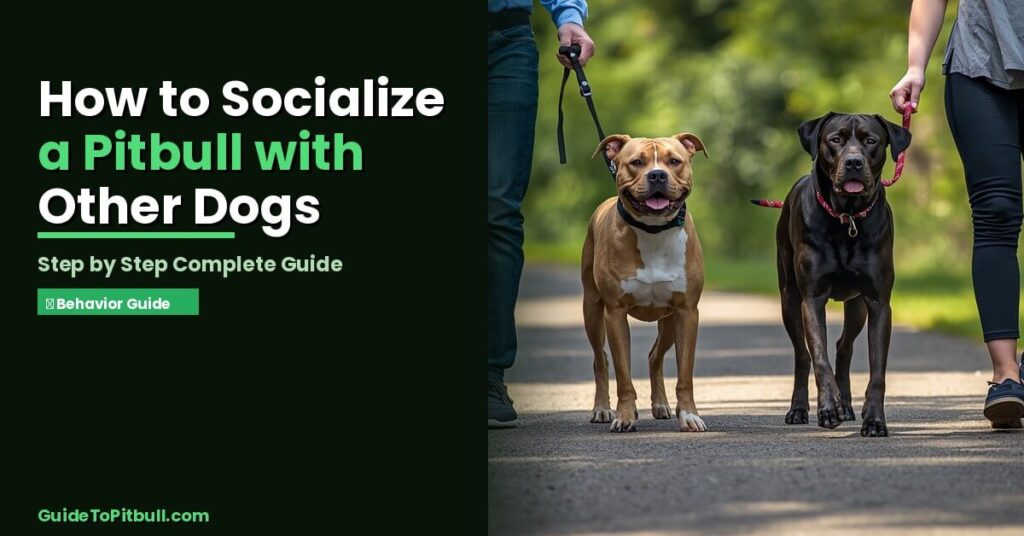
Pitbull socialization with other dogs is one of the most important — and most mishandled — responsibilities in pitbull ownership. Done correctly, it produces a confident, well-adjusted dog that can navigate the world without incident. Done incorrectly — or not at all — it creates the exact behavioral problems that put pitbulls in shelters. This step-by-step guide gives you the complete method: the critical timing windows backed by 70 years of canine behavioral research, the exact introduction protocol professional trainers use, the mistakes that set back months of progress in a single session, and how to socialize an adult pitbull when the puppy window has already closed.
- The critical socialization window is 8–16 weeks — research shows 65% of a dog’s behavior is shaped by early experience, not genetics
- Adult pitbulls CAN be socialized with other dogs — it requires more patience and a slower pace, but it works consistently
- Dog parks are NOT appropriate for pitbull socialization — one bad experience can set back months of progress
- The parallel walking method is the safest and most effective starting point for any pitbull-dog introduction
- Socialization is a lifelong commitment — not a one-time event or a puppy-phase activity
- Never punish growling or stress signals during socialization — these are the dog communicating discomfort before escalating
- Choose the right partner dog — calm, vaccinated, and neutral-tempered; not hyper, dominant, or reactive
Why Pitbull Socialization Matters: The Science Behind the Window
The research establishing why early socialization matters is not recent — behavioral scientists John Paul Scott and John Fuller identified critical developmental periods in dogs as far back as 1953. Their landmark work established that the period from 5 to 16 weeks of age represents a window during which small amounts of experience produce outsized effects on adult behavior. AKC research notes that a dog’s behavioral makeup is approximately 35 percent genetic and 65 percent shaped by socialization, nutrition, health care, training, and management.
For pitbulls specifically, this window is not just important — it is defining. The breed’s history as a working dog with elevated selective pressure toward dog-directed reactivity means that undersocialized pitbulls are significantly more likely to develop dog-directed aggression. Properly socialized pitbulls regularly coexist peacefully with other dogs. The difference between those two outcomes is almost entirely determined by what happened between 8 and 16 weeks of age — and what continues to happen throughout their lives.

| Life Stage | Age | Socialization Goal | Key Activities | Priority |
|---|---|---|---|---|
| Critical Window | 8–12 Weeks | 100+ positive exposures | People, sounds, surfaces, calm dogs | MOST CRITICAL |
| Fear Period | 8–11 Weeks | Gentle exposure only | Avoid overwhelming or traumatic events | Handle Carefully |
| Foundation | 12–16 Weeks | Broaden social circle | Puppy classes, leash walking, basic commands | Very Important |
| Adolescence | 3–12 Months | Reinforce all foundations | Daily walks near dogs, obedience training | Stay Consistent |
| Social Maturity | 12–24 Months | Manage emerging reactivity | Watch for dog aggression — intervene early | Monitor Closely |
| Adult | 2 Yrs+ | Maintain — never stop | Regular structured dog meetings, group walks | Maintain Always |
| Adult Rescue | Any Age | Build from zero safely | Parallel walking — weeks-long gradual process | Go Slow Always |
How to Socialize a Pitbull with Other Dogs: 7-Step Method
The most effective and safest method for introducing a pitbull to other dogs is the parallel walking method — used consistently by professional trainers and recommended by certified animal behaviorists. It works because it allows the dogs to develop neutral awareness of each other without the pressure and arousal that face-to-face introduction creates. Every step must be fully established before proceeding to the next. Rushing any step is the most common reason introduction attempts fail.

The quality of the first dog your pitbull meets matters enormously. Choose a calm, neutral-tempered, vaccinated dog whose owner you trust and whose temperament you know. Avoid high-energy dogs, dominant dogs, reactive dogs, or intact males. A confident, friendly adult dog that ignores other dogs is the ideal introduction partner. One bad first experience with the wrong dog can take weeks to recover from behaviorally.
Start with both dogs walking in the same direction on opposite sides of a wide path, street, or park — as far apart as needed for both dogs to remain calm. For reactive pitbulls, this may be 50 metres or more. The dogs should be aware of each other but not reacting. Reward your pitbull continuously for looking at the other dog calmly and looking back at you. This is the core of the parallel walking method — calm awareness before proximity.
Over the course of multiple sessions spanning several days, slowly reduce the distance between the dogs — a few metres at a time, always watching for stress signals. If either dog shows stiffness, whale eye, hackles, or excessive pulling, increase the distance immediately. Every session should end on a calm, positive note. Never end a session while the dog is reactive — first create distance, allow the dog to decompress, then end. Progress must be driven by the dog’s comfort level, not your timeline.
Once both dogs can walk parallel at a distance of 3–4 metres with loose leashes and calm body language, progress to walking side-by-side at the same pace in the same direction. Continue to reward calm behavior. The dogs should still not be making direct eye contact or attempting to interact — the goal is neutral coexistence while moving. Side-by-side movement is far less arousing than face-to-face interaction and is a critical intermediate step that many owners skip.
When both dogs are consistently calm walking side-by-side with loose leashes, allow a brief 3-second sniff — approaching from the side or rear, never head-on. Keep both leashes loose — tension in the leash transfers directly to the dog and increases arousal. After 3 seconds, redirect both dogs away with a treat lure. Repeat multiple times across the session, keeping each sniff brief. Brief, positive, interrupted interactions build positive associations far more effectively than extended contact.
Only attempt off-leash introduction when both dogs have demonstrated consistent calm behavior through steps 1–5 across multiple sessions. Use a neutral, fenced space that neither dog considers their territory — not your yard or the other dog’s yard. Remove leashes simultaneously — trailing leashes can tangle and cause panic. Stay relaxed and calm. Allow the dogs to interact naturally while monitoring body language. Have a plan to safely interrupt if arousal escalates.
Keep initial play sessions short — 5 to 10 minutes maximum. Interrupt play before arousal peaks: when you see stiffening, hard staring, or mounting, call both dogs away, give a short break, and restart. Playing in short, interrupted sessions teaches the dogs to regulate their own arousal levels and prevents the buildup that leads to conflict. Never leave dogs together unsupervised until you have weeks of successful interactions across many sessions.
8 Common Socialization Mistakes That Set Pitbulls Back

| Mistake | Why Owners Do It | What Actually Happens | Do This Instead |
|---|---|---|---|
| Using Dog Parks | Convenient, free, social | Uncontrolled chaos — one bad encounter = months of setback | Controlled playdate with one known, calm dog |
| Forcing Interaction | “They need to just meet” | Triggers fear → fear-based aggression develops | Let dog approach at own pace, reward curiosity |
| Wrong Partner Dog | First available dog | Hyper or dominant dog overwhelms — creates negative association | Choose calm, vaccinated, neutral-tempered dog |
| Moving Too Fast | Impatience for progress | Stress threshold exceeded — reactive behavior triggered | Each step repeated across days before progressing |
| Punishing Growling | “Growling is bad behavior” | Warning system suppressed — bites without warning later | Increase distance — address underlying cause |
| No Obedience Base | Starting socialization without training | Cannot redirect aroused dog — lose control of situation | Establish “look at me” command FIRST |
| One-Time Approach | “We did puppy class — done” | Socialization skills erode without practice | Lifelong ongoing — regular structured meetings |
| Tight Leash | Nervous about the meeting | Tension transfers — increases dog’s arousal and reactivity | Always maintain loose, relaxed leash at meetings |
- Stiff, frozen body posture in either dog — muscles locked, weight shifted forward
- Hard, unblinking stare between dogs — sustained direct eye contact is a challenge signal
- Hackles raised along the spine — particularly along the back and neck
- Tail held high and rigid — not wagging, flagging stiffly
- Growling or snapping — increase distance immediately, do not punish
- Extreme pulling toward the other dog — arousal too high for productive interaction
How to Socialize an Adult Pitbull with Other Dogs
If you have adopted an adult pitbull that was not properly socialized as a puppy, or if your pitbull has developed dog-directed reactivity, socialization is still achievable — it simply requires a longer timeline, more patience, and a willingness to work below the reaction threshold for extended periods before any progress becomes visible. The parallel walking method described above is the correct starting point for adult dogs as well, but the initial distance may need to be much greater and the progression much slower.
- Start at maximum distance — find the distance at which your dog notices the other dog but does not react, then work from there
- Progress is measured in weeks, not days — adult dogs with limited socialization history require significantly longer adjustment periods
- Build the obedience foundation first — a reliable “look at me” and “leave it” command are prerequisites, not optional additions
- Use high-value treats exclusively — regular kibble is not motivating enough in the presence of a high-arousal trigger like another dog
- Every session ends positively — if a session goes poorly, decrease distance and end on a successful calm moment before finishing
- Manage between sessions — prevent rehearsal of reactive behavior by controlling your pitbull’s environment during the training period
- Seek professional support — a Certified Professional Dog Trainer (CPDT) with positive reinforcement credentials is a worthwhile investment for reactive adult dogs
Benefits of Proper Pitbull Socialization
Well-socialized pitbulls show significantly lower arousal responses to other dogs — leash walks become manageable instead of stressful.
The attention and focus exercises used in socialization training directly improve impulse control in all contexts — not just with dogs.
Socialized dogs that are comfortable with handling and new environments experience dramatically less stress in veterinary settings.
Dogs that can encounter other dogs calmly are able to participate in public life — parks, trails, cafes — without their owner managing a crisis.
The cooperative training involved in socialization builds communication and trust between dog and owner more effectively than any other activity.
A well-behaved, social pitbull is living proof against stereotypes — every positive public interaction changes perceptions of the breed.
Frequently Asked Questions
Final Thoughts: Socialization Is a Lifelong Investment
The pitbulls that struggle with other dogs are not failed dogs. They are dogs that were failed by missed opportunities, wrong approaches, or insufficient information. Every step in this guide is backed by decades of canine behavioral research. Every technique has been applied successfully by owners and trainers working with pitbulls of all ages and histories.
The investment of time and consistency in proper socialization pays back every day — in peaceful walks, in confident public behavior, in a dog that is an ambassador for a breed that continues to be misunderstood by people who have never met a well-raised one. Socialization is not a training box to check. It is the ongoing practice of giving your pitbull the tools to navigate the world alongside you.