
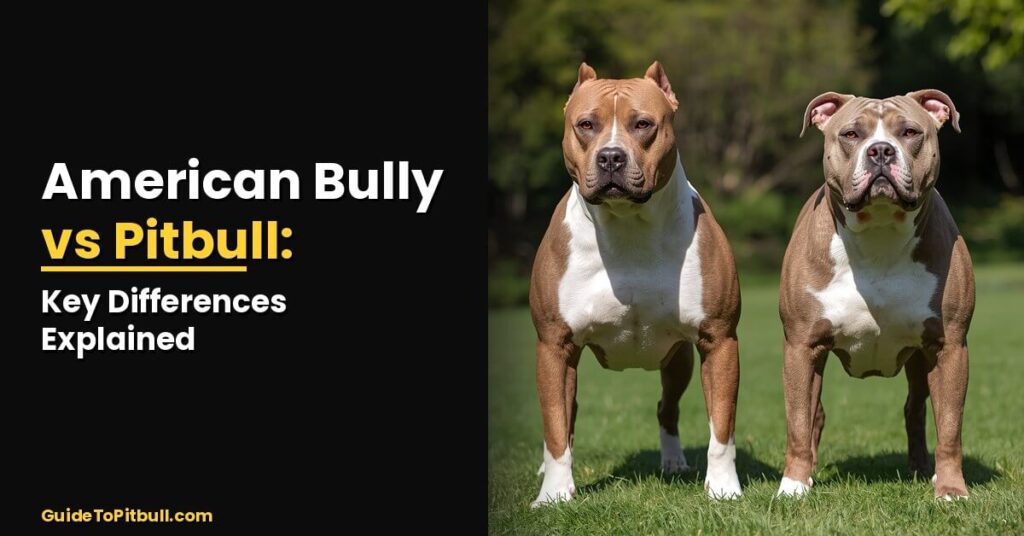
The American Bully and the Pitbull are confused for each other every single day — in shelters, in breed-specific legislation debates, in social media, and in the minds of people who see a muscular, broad-chested dog and apply a single label to all of them. They are not the same breed. They do not have the same history, the same build, the same temperament profile, or the same ownership requirements. This guide gives you the complete, accurate comparison — the real history of each breed, every physical difference broken down precisely, the honest temperament data, the size classes that make American Bullies uniquely complex, the health differences, the cost difference, and a direct, honest assessment of which breed fits which type of owner.
- The American Bully is NOT a Pitbull — it is a separate breed recognized by the UKC in 2013 and the ABKC in 2004
- The APBT (Pitbull) dates to 1800s England; the American Bully was developed in the USA in the 1980s–1990s
- Pitbulls are lean, athletic, high-energy working dogs; American Bullies are heavier, calmer, companion-bred dogs
- American Bullies come in 4 size classes — Pocket, Standard, Classic, XL — with significantly different size ranges
- The American Bully breed standard explicitly identifies aggression as a disqualifying fault — it was bred out intentionally
- American Bullies cost significantly more — $2,000 to $20,000+ vs $500 to $2,000 for APBT from reputable breeders
- Both breeds need early socialization and positive training — neither is suitable for neglectful or inexperienced owners
History and Origin: Two Completely Different Stories
The American Pit Bull Terrier — A Working Dog from 1800s England
The American Pit Bull Terrier’s history begins in 19th-century England, where breeders crossed Old English Bulldogs with terrier-type dogs to create an animal combining the bulldog’s strength and tenacity with the terrier’s speed, intelligence, and drive. These dogs were initially used in blood sports — bull-baiting and dog fighting — which were eventually outlawed. When the breed arrived in the United States with immigrant communities, it was quickly repurposed as a versatile farm dog, guard dog, hunting companion, and family pet. The UKC formally recognized the American Pit Bull Terrier in 1898, making it one of the oldest recognized working breeds in the United States. Throughout the early and mid-20th century, the APBT was among the most popular family dogs in America, appearing in wartime recruitment posters as a symbol of loyalty and resilience.
The American Bully — A Purpose-Built Companion from the 1990s
The American Bully is a genuinely modern breed. Development began in the late 1980s and accelerated through the 1990s, primarily on the East and West Coasts of the United States. Breeders combined the APBT with American Staffordshire Terriers, American Bulldogs, English Bulldogs, and in some lines, Olde English Bulldogges — with a single clear purpose: to create a companion dog with the loyal, human-focused temperament of the pit bull type but a calmer energy level, broader physical presence, and reduced animal aggression. The American Bully Kennel Club (ABKC) was established in 2004, and the United Kennel Club recognized the American Bully as its own distinct breed in 2013. Today it is one of the fastest-growing breeds globally.

Physical Differences: How to Tell Them Apart
In photographs, the American Bully and the APBT can look remarkably similar. In person, the differences are immediately obvious to anyone who knows what to look for. The APBT is built like a natural athlete — lean, proportionate, and agile, with a frame designed for endurance and speed. The American Bully is built for presence — wider, heavier, and more exaggerated in muscular development, with a larger, broader head and a lower, more compact stance.
| Physical Feature | APBT (Pitbull) | American Bully | Key Difference |
|---|---|---|---|
| Overall Build | Lean, athletic, proportionate | Stocky, broad, heavily muscled | Major |
| Weight | 30–65 lbs | 25–120+ lbs (by class) | Very Major |
| Height | 17–21 inches | 13–23 inches (by class) | Moderate |
| Head Shape | Medium — proportionate to body | Large, wide, pronounced stop | Major |
| Chest | Deep, moderately wide | Very broad, wide, prominent | Major |
| Legs | Long, proportionate — agile | Shorter relative to body — compact | Moderate |
| Snout Length | Medium-long snout | Shorter, broader snout | Moderate |
| Coat Colors | Standard range — fewer variations | Wide array incl. tricolor, merle | Minor |
| Movement | Light, agile, flowing gait | Powerful, deliberate, wide stance | Major |
American Bully Size Classes Explained — vs Pitbull
One of the most confusing aspects of the American Bully is its four official size classes, each recognized separately by the ABKC and UKC with distinct breed standards. Understanding these classes is essential because a Pocket Bully and an XL Bully are dramatically different dogs — in size, cost, health considerations, and care requirements — yet both are “American Bullies” by breed registration.

| Size Class | Male Height | Female Height | Typical Weight | Build Character | Vs Pitbull |
|---|---|---|---|---|---|
| APBT (Reference) | 18–21 inches | 17–20 inches | 30–65 lbs | Lean, athletic | — |
| Pocket Bully | Under 17 inches | Under 16 inches | 11–24 lbs | Very compact, low | Smaller |
| Standard Bully | 17–20 inches | 16–19 inches | 44–88 lbs | Heavy, broad | Heavier |
| Classic Bully | 17–20 inches | 16–19 inches | 44–77 lbs | Lighter frame | Slightly heavier |
| XL Bully | 20–23 inches | 19–22 inches | 80–120 lbs | Very large, massive | Much larger |
* Measurements per ABKC and UKC official breed standards. Actual weights vary. “Extreme” class exists in some registries but is not universally recognized and often involves health-compromising exaggerations.
📊Temperament: The Most Important Difference
The temperament difference between the American Bully and the APBT is deliberate and documented — it was the primary reason the American Bully was developed as a separate breed. Breeders specifically selected against the higher prey drive, dog-directed aggression risk, and intense working drive of the APBT to create a calmer, more universally compatible companion dog. The result is two dogs that both love people intensely but express that love very differently in daily life.
- High energy — constantly active and engaged
- Intense focus — locks onto tasks and goals
- Strong prey drive — may chase small animals
- Dog aggression possible in some individuals
- Extremely loyal — bonds deeply with owner
- Highly trainable — eager and responsive
- Thrives with a job or athletic outlet
- May be headstrong without consistent leadership
- Calmer energy — more settled indoors
- Extremely people-oriented — “velcro dog”
- Dog aggression: breed standard = disqualifying fault
- Excellent with children — very patient
- Less prey drive than APBT
- Trainable — motivated by praise and food
- Less suited to high-intensity sport
- Can be stubborn — short training sessions work best
Health, Cost and Care: Practical Ownership Differences
| Ownership Factor | APBT (Pitbull) | American Bully | Advantage |
|---|---|---|---|
| Purchase Price | $500–$2,000 | $2,000–$20,000+ | APBT |
| Exercise Need | 60–90 min daily | 30–60 min daily | Bully |
| Grooming | Low — weekly brush | Low — weekly brush | Equal |
| Lifespan | 12–16 years | 10–13 years | APBT |
| Hip Dysplasia Risk | Moderate | Higher (larger classes) | APBT |
| Breathing Issues | Low (normal snout) | Some lines — BOAS risk | APBT |
| Skin Allergies | Common in breed | Common in breed | Equal |
| Heart Conditions | Occasional | Some lines — more prevalent | APBT |
| Training Ease | High — driven and focused | Good — food motivated | APBT slight edge |
| BSL Risk | High — frequently named | Increasing — often included | Similar risk |
- Brachycephalic Obstructive Airway Syndrome (BOAS) — some heavily bred lines have shortened snouts that cause breathing difficulties, especially in heat or during exercise
- Joint stress in XL lines — extreme weight on a relatively short skeletal frame creates hip, elbow, and spine pressure that causes early arthritis
- Cardiac issues — some bloodlines show higher rates of heart conditions, particularly in Extreme class dogs
- Responsible breeder selection is critical — always ask for OFA hip and elbow certifications, cardiac clearances, and health-tested parents before purchasing any American Bully

Frequently Asked Questions
Final Verdict: Two Different Dogs for Two Different Owners
The confusion between American Bullies and Pitbulls persists because they look similar and share ancestry. But in every way that matters to an owner — energy level, exercise requirement, temperament, health considerations, cost, and the daily experience of living with them — they are genuinely different dogs that suit different types of owners.
The APBT is for the active, experienced owner who wants a driven, athletic, highly trainable working dog with exceptional loyalty and a long history as one of America’s most versatile breeds. The American Bully is for the owner who wants that same depth of human connection and loyalty in a calmer, heavier, more physically impressive package that is better suited to relaxed family life and requires less intense daily management.
Neither is better. Both require responsible ownership. The right choice is the one that genuinely matches how you actually live — not how you imagine you might live with a dog you haven’t yet met.